Spring Cable 2x3.2 mm2, PP Insulation, Red TPU Sheath, 9 mm, 40 mm Coil
Spiral & Spring Cables · Industrial Automation
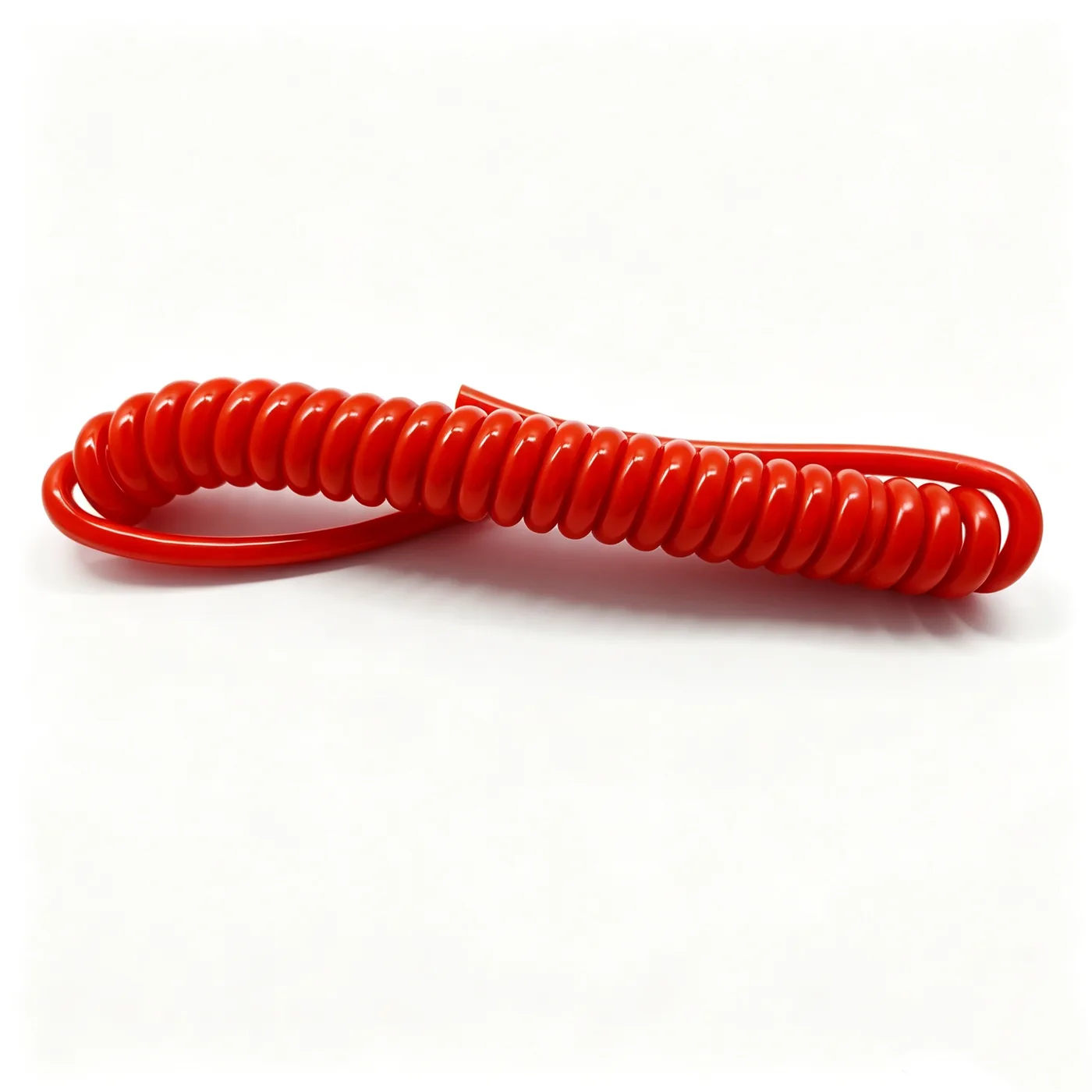
Spring cable 2x3.2
Two-core spring cable, 3.2 mm2 bare copper, 0.5 mm PP insulation, red TPU sheath, 9 mm OD, coiled to 40 mm outer diameter with 35 cm retracted length.
Product overview
Spring cables, also called spiral or coiled cables, are flexible connecting cords supplied after being coiled to a defined coil diameter and number of turns. In the free state the cable is contracted into a spring shape; when pulled it extends axially and, when the force is released, retracts to its original length by its own elasticity. They solve the power and signal connection problem where equipment is fixed at one end and moving at the other: the cable always retains slack within the travel range, while the elastic deformation of the coiled section absorbs pulling and vibration so that stress is not concentrated at one point.
Compared with a straight cable, a spring cable takes up the surplus length in the spiral structure, giving more compact routing and avoiding sagging, stacking and rubbing against moving parts; it is easier to arrange and maintain in confined spaces or where frequent extension is needed. When the machine stops, the cable gathers itself, reducing the chance of being pinched, stepped on or scraped.
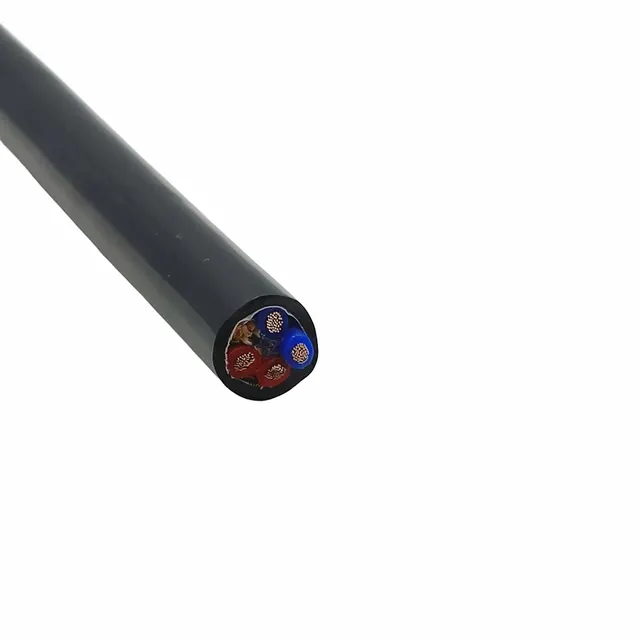
This spring cable is a two-core construction: bare copper stranded conductor, polypropylene insulation, and a thermoplastic polyurethane outer sheath; the finished cable is spiral coiled, and the straight end lengths and end treatment can be specified for the installation.
Construction and materials
From inside out, the cable consists of conductor, insulation, core filler and wrap, and outer sheath; after forming it is coiled into a spiral section. The main materials and dimensions are as follows.
- Conductor: bare copper strands; nominal cross-section 3.2 mm² per core, left-hand lay, stranded conductor diameter 2.33 mm.
- Insulation: PP, thickness 0.5 mm; insulation diameter 3.3 ± 0.05 mm; the two cores are brown and blue for circuit identification at termination.
- Cabling and filling: the two insulated cores are cabled with left-hand lay to a cabled diameter of 6.6 mm; the gaps are filled with clear PP rope and the core is wrapped with non-woven fabric to keep it round and reduce internal movement.
- Outer sheath: TPU, thickness 1.2 mm, red; applied by extrusion over the core, finished diameter 9 ± 0.15 mm, glossy surface, combining flexibility with abrasion resistance.
- Coiling: the finished cable is coiled into a spiral with a coil outer diameter of 40 mm and a retracted length of 35 cm; the straight end lengths and end treatment are determined by the installation requirements.
Key features
The conductor is stranded from many fine copper wires: small wire diameter and high strand count make the cable supple, distribute stress more evenly between wires during repeated bending, and help extend service life under repeated extension. The stranding and cabling directions are matched so the cable does not twist on itself during extension and retraction.
The insulation material has stable dielectric performance and low moisture absorption, and works reliably with the copper conductor, carrying power and signals over a wide frequency range.
The combination of filler and wrap keeps the cross-section round, prevents cores from pressing against each other or migrating during extension of the spiral section, and gives a more uniform sheath wall thickness and consistent finished appearance.
The sheath material combines elasticity with strength: abrasion, oil, low-temperature and tear resistant, with good hydrolysis and weathering performance, suited to moving parts exposed indoors and outdoors long term. The sheath is extruded tightly onto the core, so it does not wrinkle or loosen during repeated extension of the spiral section.
Electrical and mechanical performance
- Rated voltage and withstand level: determined by the project requirements and agreed in the specification document confirmed by both parties.
- Long-term operating temperature and short-term temperature resistance: material options can be selected for the environment; refer to the confirmed document above.
- Extension ratio and permissible number of extensions of the spiral section: related to coil diameter, number of turns, straight end length and installation method; recommended to determine from actual travel and extension frequency.
- Minimum bend radius and space occupied when coiled: should be checked against the formed spiral outer diameter and the installation position.
- Tensile and torsion capability: where significant pulling force must be carried during extension, an independent strength member can be incorporated and arranged separately from the electrical units so that tension is not transmitted to the conductors.
- Shielding and interference: a shield can be added where EMC requirements apply, designed together with the earthing arrangement.
Typical applications
- Power and control connections between fixed cabinets and moving tables;
- Harnesses that extend with the travel of lifting, tilting and sliding mechanisms;
- Connecting cords for inspection equipment, medical devices and similar items that are pushed and pulled frequently;
- Small-section power and signal connections between automation equipment bodies and end effectors;
- Moving connections at access control lanes, stage lighting and display equipment;
- Cases where the cable must gather itself inside a narrow cavity and a drag chain is impractical.
Selection and customisation notes
Before defining a spring cable solution, the following usually need to be clarified:
- Working travel: the range from retracted length to maximum extended length, and how frequently it is extended;
- Coil diameter and number of turns: these determine the contracted envelope and the extendable length, and must match the installation space;
- Straight end sections: their length affects termination access and routing, and can be specified separately for the cabinet side and the equipment side;
- Electrical requirements: core count, conductor cross-section, rated voltage, shielding and earthing;
- Operating environment: oil, moisture, low temperature, UV, mechanical friction;
- End treatment: whether connectors, terminals or sheath terminations are fitted, and the exit configuration.
Core count, conductor cross-section, insulation and sheath materials, colour combination, shield construction, strength members, spiral outer diameter and retracted length, straight end lengths and end connectors can all be customised per project. Different travels and environments call for different construction combinations; before the solution is fixed, state the installation position, travel range and motion type, and the specification will be confirmed by both parties.
Related in Spiral & Spring Cables
Engineering enquiry