Capabilities
Design, cabling, extrusion, screening, overmoulding and test in one facility. That vertical range is what makes a one-project construction practical rather than a special order.
Construction design
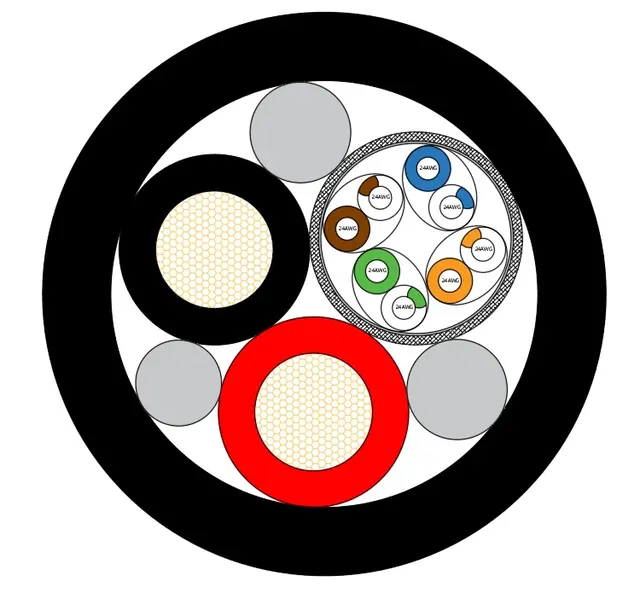
Each cable starts from the working condition: depth, pressure, tensile load, bend radius, cycle count, temperature and the connector at each end. Conductors, insulation, screening, strength member and jacket are then selected together, because they constrain each other.
Conductor and cabling
Bundled and concentric stranding, lay length control and unit grouping. Power, signal and fibre units are kept in defined positions in the core so crosstalk, stripping and termination stay predictable.
Screening and strength members
Aluminium foil with drain wire, tinned copper braid at specified coverage, and aramid or HMPE strength members sized to the load case. The strength path is kept mechanically separate from the electrical cores.
Extrusion and jacketing
TPU, PUR, PE, PVC, FEP and silicone jackets, including foamed layers for buoyancy. Wall thickness and concentricity are controlled because they set both the water resistance and the finished diameter.
Assembly and termination
Connector overmoulding, bulkhead assemblies, pulling grips, lacing and moulded plugs. Assemblies are tested as assemblies, not as cable plus parts.
Inspection and test
Continuity, insulation resistance, withstand voltage, dimensional checks, weight per metre and, where specified, water-pressure and tensile tests. Results are recorded against the construction number.
Five steps from enquiry to shipment
No construction goes into production without a signed construction sheet and, where the interface matters, a sample.
Requirement
Operating depth, load, motion, temperature, interfaces and standards — collected before a construction is proposed.
Proposal
A construction sheet: cores, sections, materials, diameter, weight, tensile rating and connector plan.
Sample
Short-length samples for fit, bend and termination checks before a full run.
Production
Cabling, extrusion, screening and assembly on the specified construction, with in-process dimensional checks.
Test & ship
Electrical, dimensional and mechanical verification, then packing to the installation method.
Materials
Jackets and insulation, chosen for the duty
Material selection is where most of the service life is decided. The same conductor in two different jackets is two different products.
| Material | Chosen for | Typical duty |
|---|---|---|
| TPU | Abrasion, cut resistance, hydrolysis stability | Subsea jackets, ROV tethers |
| PUR | Flex life, oil resistance, low friction | Drag chain, robot joints |
| PE | Dielectric strength, low water absorption | Insulation, subsea cores |
| PVC | Cost, flame behaviour, colour coding | General control cable |
| FEP / PTFE | High temperature, chemical inertness | Tethered drone, high-temp |
| Silicone | Temperature range, flexibility | High-temp, cold-flexible |
| Foamed TPU | Buoyancy compensation | Neutral buoyancy layers |
Engineering enquiry