3×0.75mm² Watertight TPU Cable, Three-Core with LCP Strength Members
Watertight Optoelectric Cables · Marine & Subsea
Custom
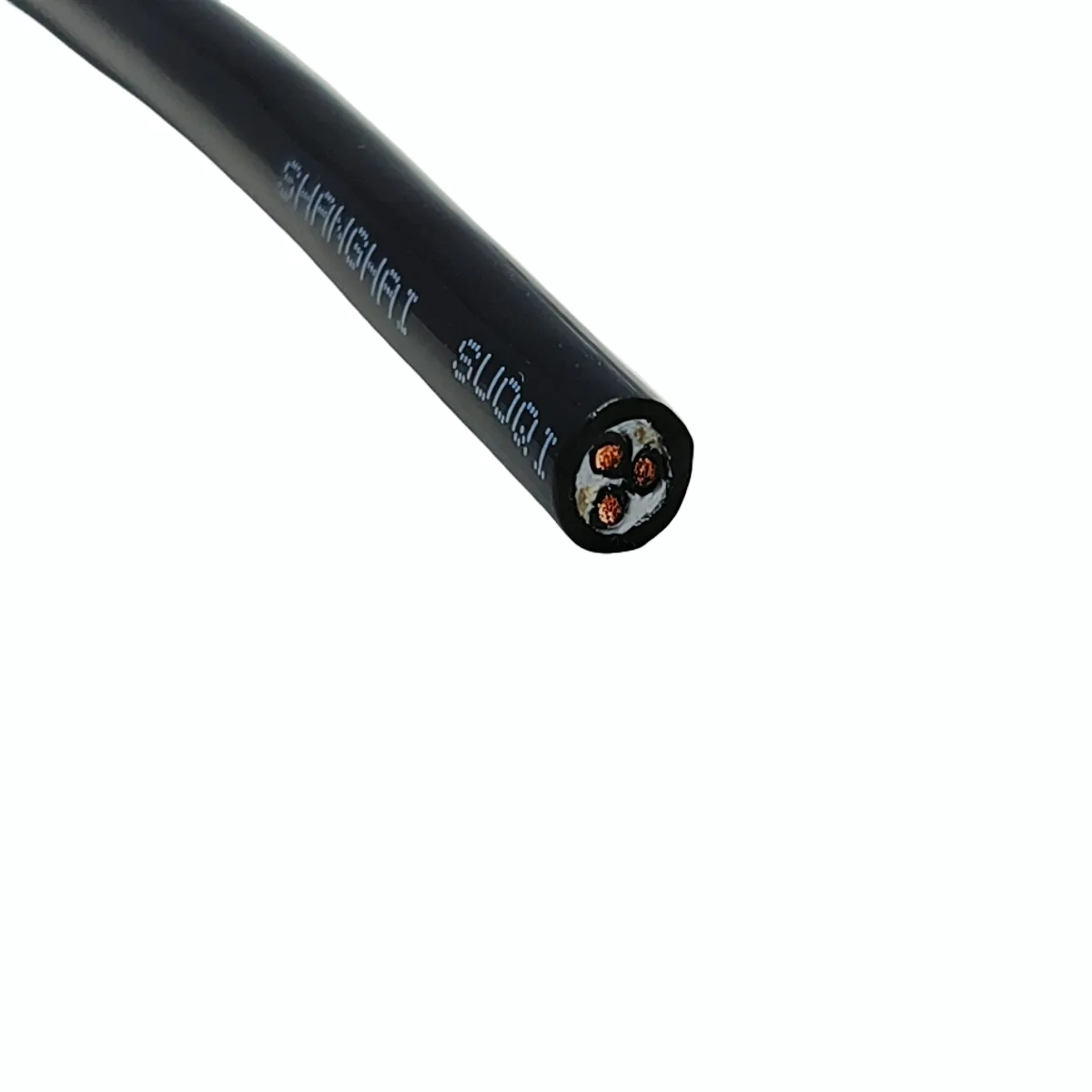
Three-core 0.75mm² watertight flexible cable with PVC insulation, two 3000D LCP strength members and a seamless TPU jacket for wet and immersed duty.
Product overview
This is a three-core watertight flexible cable designed for wet and immersed conditions, with a nominal specification of 3×0.75mm². Fine stranded copper forms the conductive body, an independent strength member and fillers are added outside the insulation, a tape layer fixes the shape, and the outermost layer is an extruded polyurethane jacket, so that the cable maintains a stable electrical path under tension, repeated bending and immersion.
The outer jacket is dense and seamless and resists water, grease and common chemical media well; the conductors, insulation and tape are lapped layer by layer and the core section is round, so it does not loosen under prolonged vibration. The product balances flexibility with environmental resistance: it suits relatively fixed installation and also moving runs of short travel with a controlled bending radius.
The cable is manufactured by PAIDE; core count, cross-section, colour, length and termination can be specified per project, and the detailed parameters are subject to the specification document confirmed by both parties.
Construction and materials
- Conductor: stranded bare copper
- Insulation: PVC, 0.5 mm thick
- Core identification: three black insulated cores, numbered 1 to 3
- Cabling: multi-core stranded, outer diameter 4.3 ± 0.5 mm, cotton yarn fillers
- Strength member: 2 × 3000D LCP fibre, laid apart from the cores
- Tape: non-woven wrapping
- Outer jacket: TPU, 1.1 mm thick, black
The conductor is a concentric strand of many fine copper wires; the small wire diameter and high wire count make the conductor flexible with good bending life, and the stranding direction is matched to the cabling direction so that the conductor does not loosen when the cable is loaded. The insulation is polyvinyl chloride, kept thin so that the insulation requirement is met while the cable stays compact.
During cabling the three insulated cores are stranded together with the strength members and cotton yarn fillers into a round core. The cotton fillers take up the gaps between cores so that the section is close to circular and does not deform after cabling; the non-woven tape further fixes the core shape and prevents cores from shifting or the jacket from sinking in during subsequent extrusion.
The strength members are two liquid crystal polymer (LCP) fibres with high specific strength and very low elongation; they carry the pull of installation and service and take the load off the conductors, so the copper is not stretched or broken. They are laid apart from the insulated cores rather than directly over the conductors, which reduces local crushing of the cores.
The outer jacket is extruded TPU, tightly fitted to the core with a smooth, even surface. The material resists abrasion, oil and hydrolysis and has a low hardness, so the cable remains bendable at low temperature and suits applications that move repeatedly in wet or oily environments.
Key features
- Watertight and environmentally resistant: dense jacket and complete core coverage suit wet conditions and short-term immersion.
- Flexible and easy to route: fine stranded conductors and a stranded core give low spring-back when bent, which helps in confined spaces.
- Separate load and current paths: pull is carried by the fibre strength members and the conductors carry almost no direct load.
- Abrasion and oil resistant: the mechanical strength and media resistance of the TPU jacket exceed those of ordinary soft jacket materials.
- Stable construction: cotton fillers and non-woven tape hold the core, so cores shift little after repeated bending.
- Flexible customisation: core count, cross-section, colour, length and termination can all be specified per project.
- Own-brand manufacture: made by PAIDE, with models and specifications matched to project drawings.
Electrical and mechanical performance
Rated voltage, service temperature range, minimum bending radius and conductor DC resistance are set per project and subject to the specification document confirmed by both parties. The geometry and main construction parameters are as follows:
- Finished outer diameter: 6.5 ± 0.3 mm
- Conductor: multi-wire fine copper strand, tightly stranded
- Good concentricity of insulation and jacket, no blisters, inclusions or mechanical damage on the surface
Mechanically the cable shows good tensile, flexing and abrasion performance: pull is carried mainly by the strength members, so the cores see little tension; the jacket material is tough and withstands friction and crushing during installation; the stranded core lets the layers slide slightly against each other under repeated bending, which reduces internal stress concentration.
Electrically, the copper conductors ensure stable current transfer, the PVC insulation isolates the cores from one another and the TPU jacket forms a continuous outer barrier that keeps water and contaminants out and protects the insulation level. Specific withstand voltage and insulation resistance values are set per project and recorded in the specification document confirmed by both parties.
Typical applications
- Signal, control or power connections for underwater equipment and subsea work gear
- Internal wiring of immersion test rigs, marine and offshore engineering equipment
- Connections for equipment that moves frequently in wet or oily environments
- Instrument leads that need both flexibility and tensile capability
- Fixed installation and control circuits outdoors and in areas close to water
Selection and customisation
At selection, first define the service environment (prolonged immersion, oil or chemical media), the installation mode (fixed or moving), the required core count and cross-section, the permitted minimum bending radius, and whether strength members and what tensile capability are needed.
- Core count, cross-section, colour and jacket material can be set per project; core colours can be coded to simplify identification at termination.
- Where higher tensile capability is needed, the specification and number of strength members can be adjusted.
- For longer continuous runs, reel length and jointing method can be confirmed before delivery.
- During installation and service, stay above the minimum bending radius given in the specification document and avoid sharp bends and crushing by hard objects.
- State any special temperature, flame-retardant or hydrolysis requirements in advance so that insulation and jacket materials can be confirmed.
The construction and parameters above are the standard configuration; final specifications, test requirements and delivery condition are subject to the specification document confirmed by both parties.
Manufacture and quality control
From conductor stranding, insulation extrusion, cabling and taping to jacket extrusion, the processes run in sequence and are inspected at each stage. The conductor stage checks the stranding pitch and wire arrangement, the insulation stage checks thickness and eccentricity, the cabling stage checks core roundness and filling, and the jacket stage checks the extruded surface and finished diameter. After take-off, appearance, dimensions and electrical items are checked as required by the specification document before the cable is released to stock and delivery.
The cable is manufactured by PAIDE under its own type system and standard construction configurations; the construction can be adapted to project requirements, and the technical details are subject to the specification document confirmed by both parties.
Related in Watertight Optoelectric Cables
Engineering enquiry