Crane Drum Cable 7×14AWG+10×18AWG 18 mm
Crane & Hoist Drum Cables · Industrial Automation
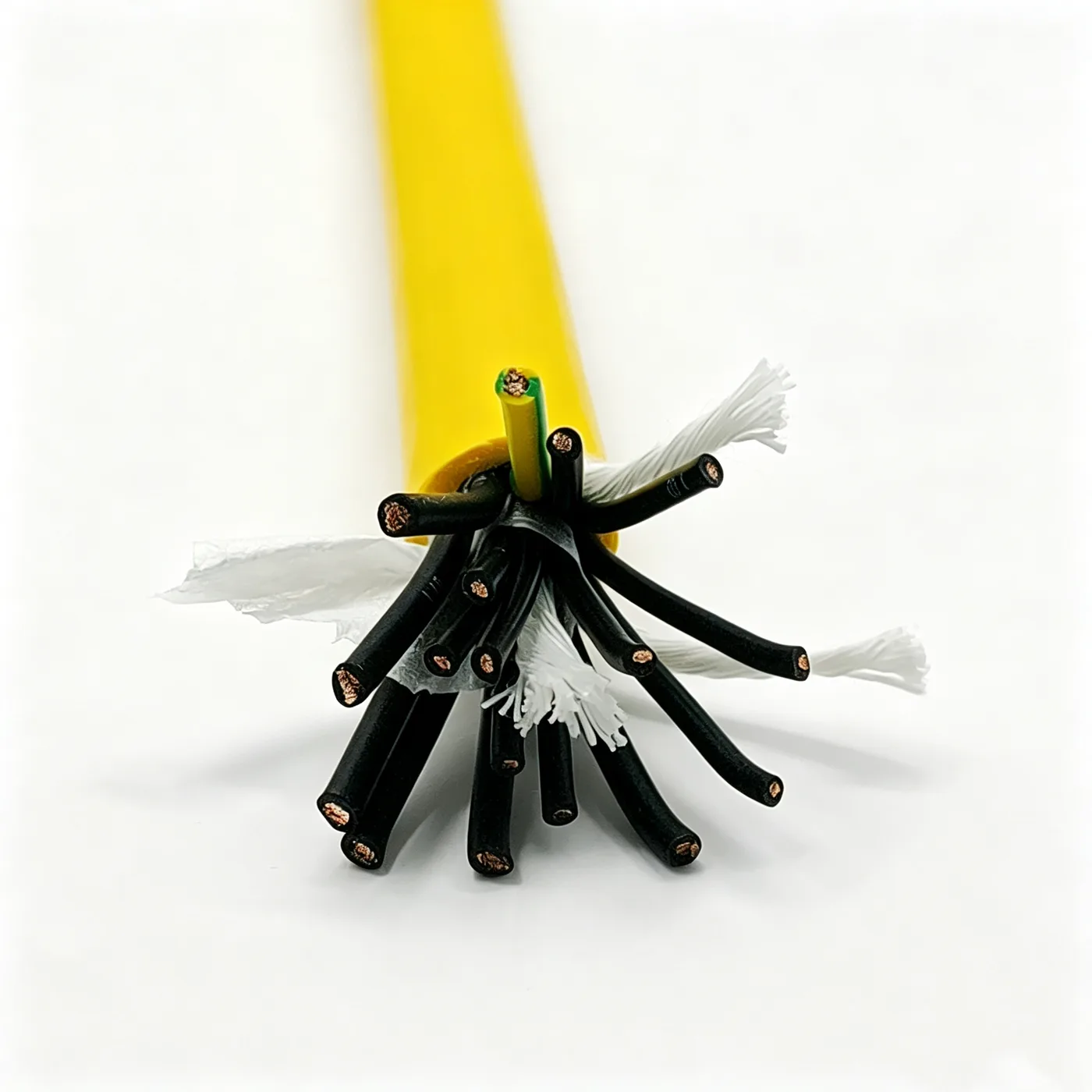
Crane drum cable 7×14AWG+10×18AWG
Seventeen-core crane drum cable with 7×14AWG power and 10×18AWG control cores, tinned copper, PVC insulation and a yellow NBR sheath at 18 mm.
Product overview and use
This cable is a 7×14AWG+10×18AWG multi-core flexible drum cable with 17 insulated cores: 7 power cores (including one yellow-green earth core) and 10 control cores. Both power and control cores are identified by number for termination, checking and later maintenance on site. Conductor construction, insulation thickness, and cabling and outer sheath dimensions are listed in the construction and materials and the electrical and mechanical performance sections; this section gives a qualitative description only.
The cable is used for mobile power supply and signal transmission on cranes, hoists, travelling cranes, grabs and similar equipment that requires frequent reeling and unreeling. In such duty the cable is continuously subjected to winding tension, repeated bending and lateral compression, so conductor flexibility, insulation concentricity, cabling tightness and sheath abrasion and oil resistance are all subject to specific requirements.
Unlike a fixed installation cable, a drum cable passes through straightening, bending and winding in every hoisting cycle, and the load direction in each layer of the core changes continuously. If the conductor strands are too coarse or the stranding too loose, the copper strands fatigue and break under repeated bending; if the cable is not round enough, adjacent cores press against each other during winding and the insulation eventually suffers. This cable is therefore organized around mobile duty at three stages - conductor, cabling and sheath: power and control cores are numbered separately, and during cabling the larger cores are placed at the centre with the smaller cores in the outer layer, so that the bending neutral axis stays as close to the centre as possible.
Conductor
The power core conductor is bunched from tinned copper strands in a stranded construction with a cross-section of approximately 2.0 mm² and a stranded diameter of approximately 1.84 mm, left-hand lay. The control core conductor is likewise bunched tinned copper, made up of 44 strands of the same specification, with a cross-section of approximately 0.78 mm² and a stranded diameter of approximately 1.15 mm, left-hand lay. The tin coating reduces oxidation of the copper strands in damp, sulfur-containing environments and aids subsequent soldering and crimping, giving more stable contact resistance over long service.
Insulation
The insulation is an 80℃ PVC compound. The nominal thickness of the power core insulation is 0.7 mm, giving an insulated core diameter of about 3.2 mm; the control cores use the same insulation thickness with an insulated core diameter of about 2.6 mm. The power cores are black, numbered 1 to 6, plus one yellow-green earth core; the control cores are black, numbered 1 to 10.
Cabling and fillers
The cores are arranged in numerical order during cabling, with the power cores at the centre and the remaining cores laid up in sequence. The lay direction is left-hand and the cabled diameter is about 14.3 mm. Cotton yarn fills the interstices so that the core is round and evenly loaded; non-woven tape is wrapped over the core for separation and cushioning, reducing friction between cores and preventing the core from being crushed during sheath extrusion.
Sheath
The sheath material is nitrile rubber (NBR), yellow, applied by pressure extrusion with a nominal thickness of about 1.8 mm and a finished outer diameter of 18±0.2 mm. Nitrile rubber offers good oil, abrasion and tear resistance, which suits workplaces with oil contamination and dust; the pressure-extruded sheath bonds closely to the core and does not slip relative to it during repeated winding.
Key features
- Multi-core composite construction: power and control cores in one cable, so a single cable carries both power supply and control signals and fewer cables are needed on the drum
- Tinned copper conductor: oxidation resistant and easy to solder, for more reliable contact
- Flexible design: fine-strand bunched conductors with a tight stranding construction give a smaller bending radius for frequent winding and unreeling
- Cotton fillers and non-woven tape: improve core roundness and compression resistance and stabilize winding
- Nitrile sheath: oil resistant, abrasion resistant and tear resistant, for industrial and outdoor environments
Electrical and mechanical performance
- Mechanical behavior in mobile duty is determined mainly by conductor strand diameter, stranding construction and sheath thickness; the values are given in the construction and materials section
- The tinned copper conductor gives more stable contact resistance in damp, sulfur-containing environments, which supports the long-term reliability of control circuits
- The pressure-extruded sheath bonds closely to the core, reducing sheath slip relative to the core during repeated winding and lowering the risk of cores being compressed
- During installation the cable should be wound evenly on the drum without overlapping or crossing; the bending radius during winding and towing should not be too small
- Rated voltage, insulation resistance, withstand voltage and finished length are subject to the specification document confirmed by both parties
The electrical values and the mechanical life of a drum cable need to be assessed together: insufficient conductor flexibility causes fatigue breakage under repeated winding, insufficient insulation concentricity and cabling tightness reduce long-term withstand performance, and insufficient sheath abrasion and oil resistance lead to premature ageing in oily, dusty environments. If local overheating, sheath wear exposing cores or unstable control circuit signals occur in service, the drum winding pattern, the contact between guide rollers and cable, and the loading of the cores should be checked, and the construction should be reviewed with the supplier.
Typical applications
- Drum power supply and control for the main hoist and trolley travel of cranes
- Trailing cable and reeling systems for overhead and gantry cranes and travelling cranes
- Winding power distribution for grabs and handling machinery
- Mobile workplaces with heavy oil contamination and dust, such as metallurgy, ports and freight yards
- Drum reeling equipment that must transmit power and control signals in the same cable
In these applications the cable usually works with drums, guide rollers and sheave blocks; the longer the winding travel and the higher the operating frequency, the greater the demands on conductor flexibility, core roundness and sheath abrasion resistance. Placing the power and control circuits in one cable reduces the number of cables on the drum and the space they occupy, and simplifies inspection during maintenance.
Selection and customization
- Core count and cross-section can be adjusted to the actual power load and the number of control circuits; in practice control cores are added to or removed from the power core basis
- Where higher tensile loads must be carried, aramid or steel wire strength members can be added to the core; the exact construction is subject to the specification document confirmed by both parties
- Control circuits requiring interference immunity can be given aluminum foil or braided shielding over the control cores
- Sheath color, surface marking and finished length can be customized to project requirements
- During installation the cable should be wound evenly on the drum without overlapping or crossing; the bending radius during winding and towing should not be too small
- Before selection, the ambient temperature, oil and dust conditions, operating speed and winding travel should be established so that the insulation and sheath material can be confirmed
Related in Crane & Hoist Drum Cables
Engineering enquiry