Crane Drum Cable 7x14AWG+8x18AWG+1x2x22AWG - 16 mm OD, NBR Sheath
Crane & Hoist Drum Cables · Industrial Automation
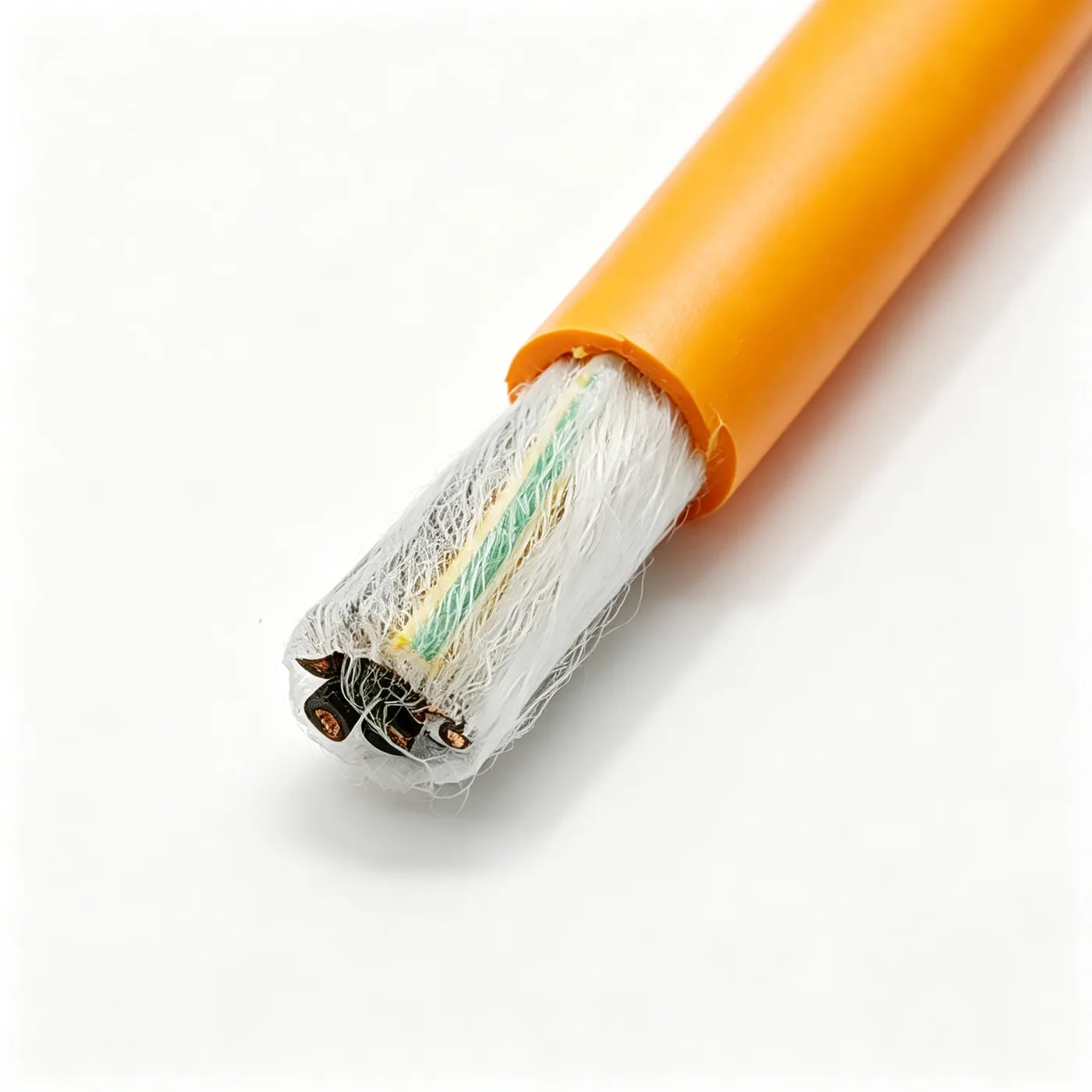
Drum cable 7x14AWG+8x18AWG+1x2x22AWG
Crane drum cable with seven 14AWG power cores, eight 18AWG control cores and one shielded 22AWG signal pair, NBR sheath, 16 mm outer diameter.
Product overview and use
This product is a composite cable developed by PAIDE Cable for the drum take-up systems of lifting machinery, model 7x14AWG+8x18AWG+1x2x22AWG. A single cable integrates the power circuits, the control circuits and one twisted shielded signal pair, so the drum only has to handle one cable to supply the equipment, control its motions and collect signals, removing the risk of crushing, tangling and knotting that arises when several cables are laid in parallel.
Drum cables are repeatedly subjected to tension, bending, torsion and friction during take-up and pay-off, which places high demands on structural stability. This product uses fine-strand conductors for flexibility, PVC insulation for electrical separation, cotton filler and non-woven wrapping to stabilize the core, and a nitrile sheath against oil, moisture and mechanical wear, making it suitable for continuous reciprocating operation outdoors and in damp or oily environments.
Construction and materials
Seven power cores (power transmission)
- Conductor: bare copper strands, left-hand lay, stranded diameter 1.84 mm
- Insulation: PVC (temperature class 80 C), 0.7 mm thick, insulation diameter 3.2 mm; one core is yellow-green and the others are black
Eight control cores (control circuits)
- Conductor: bare copper strands, left-hand lay, stranded diameter 1.15 mm
- Insulation: PVC, 0.5 mm thick, insulation diameter 2.2 mm, black cores
One twisted signal pair (signal and communication)
- Conductor: tinned copper strands, stranded diameter 0.75 mm
- Insulation: PVC, 0.42 mm thick, insulation diameter 1.6 mm, black and white to distinguish polarity
- Shield: the black and white cores are twisted, covered with aluminium foil and tinned copper braid (80% coverage), then wrapped with polyester tape
Cabling and outer sheath
- Cabling: the seven power cores are placed in the center of the core, the control and signal cores are arranged in order in the outer layer, left-hand lay, cabled diameter 13 ±0.5 mm
- Filler: the voids in the core are filled with cotton yarn, and non-woven tape is wrapped over the cable core
- Outer sheath: nitrile rubber (NBR), 1.5 mm thick, orange, finished outer diameter 16 ±0.5 mm
Fine-strand stranding is the basis of flexibility in this type of cable: individual wires can slide against each other in bending, bending stress inside the conductor is lower than in a single thick conductor, and spring-back is smaller, which suits repeated take-up on a drum. The power cores use bare copper for good conductivity and stable mechanical strength; the signal cores use tinned copper, where the tin layer improves oxidation resistance and eases subsequent soldering. The signal circuit uses a twisted pair with a composite shield: twisting makes interference appear as common mode on the two cores, the aluminium foil blocks electric field interference, the tinned copper braid suppresses magnetic field interference, and an outer polyester tape keeps the shield flat and stable against the insulation.
Placing the seven power cores in the center of the core balances the loads when the cable is taken up and paid off; the control and signal cores are arranged around the center, so that tension and compression are relatively even in all directions during bending and cores are unlikely to shift or the sheath to bulge. Cotton yarn fills the voids between cores and keeps them from loosening and moving after cabling; the non-woven tape wrapped over the core both prevents the insulation from sticking to the sheath during extrusion and cushions the core. The sheath is applied by extrusion with an even thickness and a smooth surface, combining abrasion, oil and tear resistance, and the conspicuous sheath color makes the cable easy to identify among equipment and in stockyards.
Key features
- Integrated construction: power, control and signal circuits are combined in one core, which reduces the number of cables routed on the drum and the associated installation and maintenance work
- Strong interference rejection: the signal pair uses aluminium foil plus tinned copper braid composite shielding, suppressing interference from power circuits and variable-frequency drives for more stable signal transmission
- Flexible and bend-resistant: fine-strand conductors with thin insulation keep the cable soft, which suits repeated bending at small radii
- Stable structure: power cores in the center and orderly cabling keep the core from loosening and the sheath from wrinkling during take-up and pay-off
- Durable sheath: the nitrile sheath resists mineral oil, hydrolysis, abrasion and tearing, and suits outdoor and damp conditions
- Easy identification: the yellow-green core among the power cores identifies the earth connection, and the uniform control core color simplifies wiring
Electrical and mechanical performance
Rated voltage, withstand level and insulation resistance are confirmed according to the specific operating conditions and the selected material construction; factory inspection is carried out to the applicable standards, and actual values are subject to the specification document confirmed by both parties.
Mechanically, the tensile load the cable can take, the minimum bending radius, the drum diameter, the take-up speed and the number of winding layers are interrelated and must be determined together with the installation method. Traction tension should be kept within a suitable range during use, the cable should be wound evenly, and the cable should not be squeezed or bent excessively at the drum flange; when winding in several layers, adequate allowance should be left to prevent flattening, knotting or sheath damage during take-up and pay-off.
When the cable is used outdoors or in damp conditions for long periods, the oil, hydrolysis and abrasion resistance of the sheath are the key factors in service life; before installation, check that the drum and guide rollers are smooth and free of burrs to reduce sheath wear and extend the service period.
Typical applications
- Power supply, control and signal transmission on the drums of tower cranes, gantry cranes and overhead travelling cranes
- Mobile power supply and interlock control for grab cranes, handling machinery and stacker-reclaimers
- Power and signal connections for winches, hoists and hauling gear that require frequent reciprocating take-up
- Equipment supply lines in ports, docks, stockyards and mines under open-air, damp and oily conditions
- Mobile electrical equipment that must transmit power, control and communication signals in one cable
Selection and customization notes
- Core count, conductor cross-section and core combination can be adjusted to the number of circuits on the equipment, and sheath color can be agreed as required
- The number of signal pairs and the shield type can be selected to suit the communication protocol and interference requirements
- Where higher tensile loads must be carried, the cable can be combined with strength members to form a reinforced construction
- Before selection, please clarify drum diameter, winding method, take-up speed, maximum tensile load and service environment, and verify with a sample where necessary
- Finished length is calculated from the actual routing path and the number of turns on the drum; specific values are subject to the specification document confirmed by both parties
Related in Crane & Hoist Drum Cables
Engineering enquiry