PDK71300-2x4mm2+STP CAT5 Pipeline Robot Cable, 0.6/1 kV, TPU, 12.4 mm
Pipeline Inspection Robot Cables · Industrial Automation
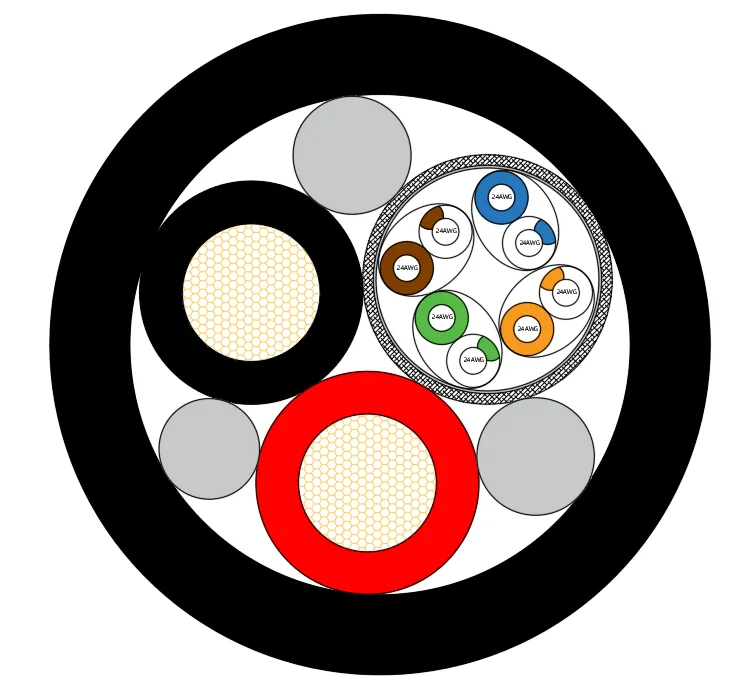
PDK71300
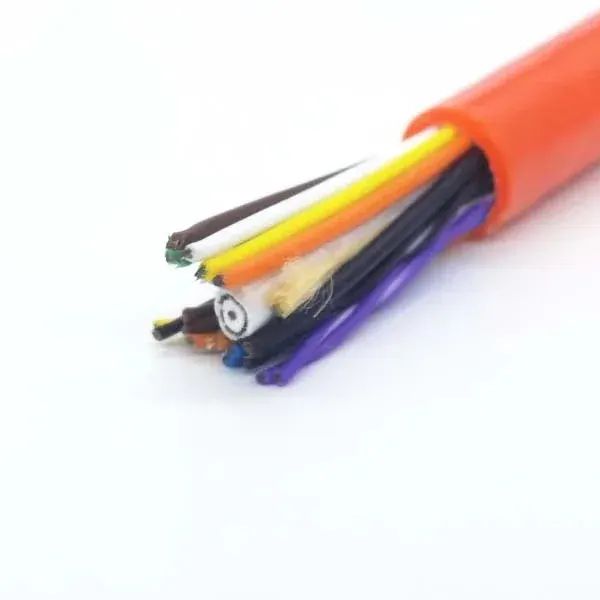
Pipeline robot cable combining 2x4 mm2 power cores with a shielded STP CAT5 data component, foil and tinned copper braid, TPU sheath, 0.6/1 kV, 12.4 mm OD.
Product overview and use
PDK71300-2x4mm²+STP CAT5 is a combined power and network cable developed by PAIDE Cable for pipeline inspection robots, pipeline crawlers and borehole survey equipment. The design places two power cores and one shielded data network component in a single cable, so that power supply and video and control signal transmission share one channel while the robot travels through the pipe, reducing the number of parallel cables and connectors on site, simplifying the deployment mechanism and lowering the joint failure rate.
The working environment of pipeline robots is usually narrow and wet, and may involve oil contamination and mild acid or alkaline media; the cable must be deployed and recovered repeatedly with the robot and bent continuously at pipe walls and elbows. The design therefore emphasises suppleness and sheath mechanical strength, while the data component retains a complete shield so that video and network signals keep stable characteristic impedance and interference immunity over longer distances.
Construction and materials
This section lists the conductor, insulation, shielding, filling and outer sheath configuration of the model; the following subsections give qualitative descriptions only.
For the conductors, the power cores use bare copper; the cross-section is the nominal value in the model designation, the conductor is stranded, and the stranded diameter is approximately 2.6 mm. The data cores have a cross-section of 0.2 mm² and form an STP CAT5 network component; the conductor is stranded with a stranded diameter of approximately 0.61 mm. Fine-strand stranding gives good flexibility for repeated pulling through pipes with a restricted bend radius.
The insulation is polyethylene (PE). Power core insulation has an average thickness of 0.8 mm and a minimum thickness of 0.68 mm, with an insulation diameter of 4.2 ± 0.04 mm; data core insulation has an average thickness of 0.2 mm and a minimum thickness of 0.17 mm, with an insulation diameter of 1.0 ± 0.04 mm. The power cores are insulated in red and black for polarity identification on site; the data cores follow the default colour sequence to aid pair identification and termination.
For shielding, the STP CAT5 data component uses a composite shield of aluminium foil plus tinned copper wire braid: the twisted pairs are foil-wrapped and then braided with tinned copper to form a continuous shielding path that suppresses interference from current changes in the power cores. The power cores themselves are unshielded, keeping the core construction relatively simple.
PP filler rods are used for filling and cabling, supporting and rounding the core so that the power cores and the data component keep a stable relative position after cabling, reducing friction and displacement between cores during bending and helping maintain a uniform diameter during sheath extrusion.
The outer sheath is TPU polyether polyurethane, black, with an average thickness of 1.5 mm, a minimum thickness of 1.3 mm and a finished diameter of 12.4 ± 0.3 mm. The TPU sheath offers good abrasion, oil, hydrolysis and low-temperature resistance, suited to wet pipe galleries, oily environments and outdoor duty.
Key features
- Combined power and network: one cable carries power and data communication, does not tangle easily during deployment, and noticeably reduces the number of field joints.
- Highly flexible construction: fine-strand conductors give a relatively small minimum bend radius, suited to repeated bending with the robot through elbows and reducing pipe sections.
- Interference-resistant data channel: the data component has a composite aluminium foil plus tinned copper braid shield and, with stable characteristic impedance, supports reliable long-distance video and network transmission.
- Good sheath mechanical performance: the TPU sheath is abrasion, oil, hydrolysis and weather resistant and copes with the wet and oily environment inside pipes.
- Wide temperature range: the temperature rating covers most field and underground working conditions.
- Tensile reinforcement configurable: the original specification of this model does not set a fixed tensile value; users can choose aramid braid reinforcement or another reinforcing method according to deployment length and pulling force.
Electrical performance
This section lists the electrical and mechanical ratings of the model.
- Rated voltage: 0.6/1 kV.
- Maximum DC conductor resistance at 20 °C: power cores (nominal cross-section as in the model designation) not more than 4.64 Ω/km; data cores not more than 84.1 Ω/km.
- Data component characteristic impedance: 100 ± 10 Ω.
- Minimum bend radius: 10xD, where D is the finished cable outer diameter.
- Rated temperature: -40 °C to +105 °C.
- Sheath material: TPU polyether polyurethane, black.
The power cores carry the power supply for the whole cable, and line voltage drop varies with installed length and load current; the data component maintains stable characteristic impedance through its full shield and twisted-pair construction, so video images and control commands can be returned reliably over longer distances. Voltage drop, temperature rise and signal quality in service should be assessed together with installed length, ambient temperature and termination method.
Typical applications
- Pipeline CCTV inspection robots and pipeline crawlers: power and video signal over one cable, deployed as the robot enters and leaves the pipe.
- Borehole measurement, underground geophysical survey and pipeline exploration equipment: mobile power for downhole instruments with data and images returned to the surface.
- Industrial maintenance and confined-space work: combined power and network wiring for mobile equipment in pipe galleries, flues and tanks.
- Mobile inspection devices requiring both power and stable network communication, and short-distance towing applications with reel deployment.
Customisation and ordering notes
The power core cross-section, core count, data component category (for example CAT5 or CAT6) and shielding method can all be adapted per project; sheath material and colour can be selected for the environment, with TPU preferred for wet or heavily oil-contaminated locations, and weatherability requirements for long-term outdoor exposure can be discussed with PAIDE Cable. For longer deployment distances or higher pulling forces, aramid braid reinforcement can be added to the core with a corresponding tensile rating.
When ordering, please provide: working length and deployment method, maximum towing force, site ambient temperature, contact media (water, oil, acid, alkali), video and data transmission distance and rate requirements, permissible finished diameter and bending space, termination method and print marking. With complete information, PAIDE Cable can propose a matching construction and samples; if an existing model does not match exactly, the construction and materials can be adjusted within the existing PAIDE Cable product family.
Related in Pipeline Inspection Robot Cables
Engineering enquiry