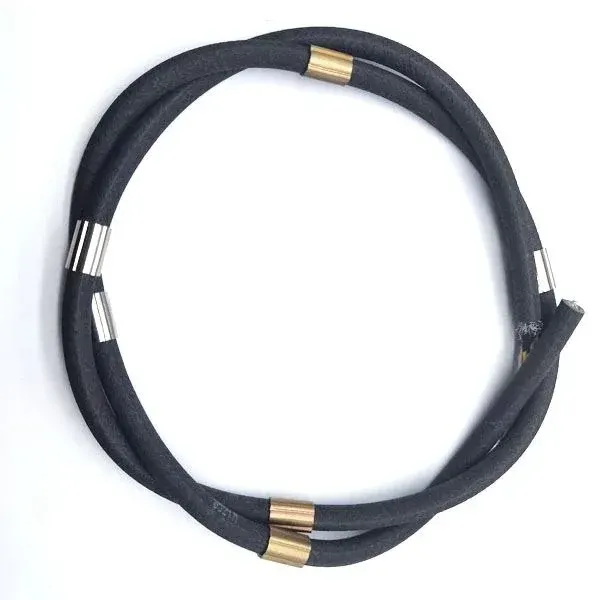
PDK41904 2x14AWG+2SMF Tethered Aerostat Optoelectric Cable
Specialty & Instrumentation Cables · Industrial Automation
PDK41904
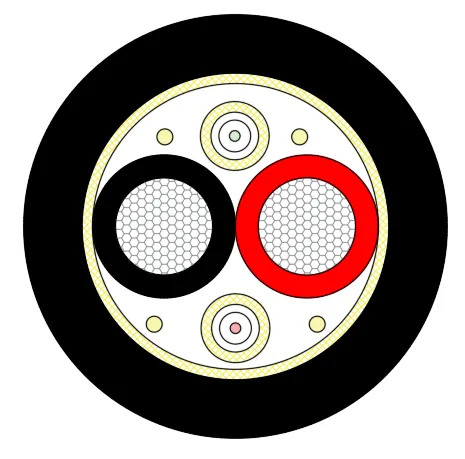
Tethered aerostat optoelectric cable with 2x14AWG tinned copper cores and two armored single-mode fibers, 1000 N tensile, 8.2 mm OD.
Product overview
A tethered aerostat or tethered drone is supplied with power, carries data and is mechanically towed by a single cable while it works. The platform stays aloft for long periods, the cable is repeatedly payed out and recovered by a winch, and it must also withstand the extra tension of gusting wind, so weight, tensile strength, flex resistance and signal stability are all demanding. The PAIDE PDK41904 series is the optoelectric construction in the airborne tethered cable range: two power cores and two armored single-mode fibers are laid side by side in the core, so one cable provides high-current supply and long-distance data return at the same time, reducing the number of harnesses in the suspension system and simplifying the winch and pay-out arrangement.
The series is designed around low weight and reliable recovery in wind. Sheath materials are mainly PE, TPU, PUR and TPEE, selected for different tension classes and working environments; models with fibers keep the optical signal over heights of several hundred meters and more, and suit the telemetry and video return links of airborne platforms.
Construction and materials
The main model described here is PDK41904-2x14AWG+2SMF. Its conductor is stranded tinned copper, multi-strand, with a stranded diameter of 1.84 ±0.1 mm; the tin coating helps suppress oxidation of the copper in damp conditions. Insulation is FEP, average thickness 0.43 ±0.05 mm with a minimum point of 0.36 ±0.05 mm, insulation diameter 2.7 ±0.1 mm, in black and red to identify polarity on site.
Two armored single-mode fibers run in the same cable; the armoring gives mechanical protection at small diameter, the finished fiber diameter is 2.0 ±0.08 mm and there are two fibers. The filling consists of tensile strength members combined with 3000D LCP, and the braid layer is also LCP, binding power cores, fibers and strength members into one unit so that all elements share the load when the cable is tensioned. The sheath is black PUR, average thickness 1.2 ±0.1 mm with a minimum point of 1.1 ±0.05 mm, finished cable diameter 8.2 ±0.3 mm.
Key features
- Power and fiber in one cable: one cable carries power and single-mode optical signals, reducing the number of tethers and suspension interfaces.
- Low weight: two power cores and two fibers are integrated at small diameter, which reduces the load on the suspension system.
- Tensile capability: the breaking force covers the towing needs of small and medium tethered platforms, with strength members and fibers loaded together.
- Smooth pay-out: the minimum bending radius is controlled as a multiple of the cable diameter, suiting repeated winch operation.
- Wide temperature range: the rating covers severe cold to high temperature, matching the temperature difference between ground and altitude.
- Fiber performance: single-mode attenuation is held low in the two common communication windows, supporting long-distance data return.
Electrical performance
- Rated voltage: 300/500 V
- Maximum conductor DC resistance (20 °C): 9.2 Ω/km
- Breaking force: 500 kg
- Minimum bending radius: 20D (D = cable outer diameter)
- Rated temperature: -30 °C to +105 °C
- Fiber attenuation: ≤0.5 dB/km at 1310 nm, ≤0.3 dB/km at 1550 nm
Insulation and sheath thickness are controlled both as average thickness and minimum point, so the cable keeps full electrical insulation and mechanical protection margin while being bent and wound. Voltage class, core count and fiber count can be adjusted to platform power and transmission distance.
Related models in the series
The airborne tethered cable series covers combinations from light small-diameter types to high-tension heavy-duty types. The following are existing specifications in this PAIDE series, for comparison during selection.
- PDK41904-2x1.2mm²: alloy wire conductor, FEP insulation, 1500D LCP braid reinforcement, TPU sheath, finished diameter 5.4 ±0.1 mm, weight approx. 31 g/m, tensile 1000 N, maximum conductor DC resistance 15.8 Ω/km, same rated voltage as the main model, rated temperature -40 °C to +105 °C, minimum bending radius 10 times the cable diameter, for weight-sensitive short-range platform supply.
- PDK41604-7x1.0mm²: tinned copper conductor, FEP insulation, 57 LCP fiber wraps (0.7 mm thick) with polyester tape and non-woven wrapping, TPEE sheath, finished diameter 13.6 ±0.5 mm, tensile 26000 N, weight approx. 310 g/m, rated voltage 2000 V, rated temperature -40 °C to +120 °C, minimum bending radius 15 times the cable diameter, for higher-tension duties.
- PDK41601-3x3mm²+3x0.56mm²-1t: combines 3 mm² and 0.56 mm² cores, both multi-strand conductors; maximum conductor DC resistance 6.2 Ω/km for the larger cores and 33.7 Ω/km for the smaller, finished diameter 10.4 ±0.3 mm, tensile 1 t, weight approx. 172 g/m, rated voltage 450/750 V, rated temperature and minimum bending radius as the lightweight alloy-wire specification above, covering both power supply and signal cores.
- PDK41304 3x0.53mm²+3SMF-6000KG: multi-strand tinned copper conductor, PE insulation (average thickness 0.77 mm), three single-mode fibers, four layers of aramid fiber wrapping for a 6000 kg design tension, aluminum foil and steel wire shield reinforcement, TPU sheath average thickness 0.8 mm, finished diameter 14.8 ±0.2 mm, maximum conductor DC resistance 34 Ω/km, rated temperature as the main model, minimum bending radius 25 times the cable diameter.
- PDK41302-2x22AWG+1SMF: optoelectric construction with one single-mode fiber, finished diameter 3.4 ±0.3 mm, rated 1 kV DC, minimum bending radius 65 mm, rated temperature as the lightweight alloy-wire specification above, for short-distance low-tension telemetry links.
Typical applications
- Power supply and data return for tethered drone platforms: two power cores deliver energy to the platform and two single-mode fibers carry payload data back to the ground.
- Telemetry for tethered balloons and aerostats: stable power and optical channels during long endurance, with the winch handling ascent and recovery.
- Optoelectric transmission for airborne platforms: where power transfer and high-bandwidth communication must be solved on one cable.
- Ground pay-out and winch systems: small diameter and small bending radius make multi-layer spooling easier.
Customization and selection notes
Selection should start from three conditions: the platform's operating voltage and power demand, the required tension class, and the fiber count and type that match the transmission distance. Conductor cross-section, core count, fiber count, strength member type and sheath material can all be customized; for long-term outdoor exposure, weather- and abrasion-resistant sheath materials are preferable, while for frequent pay-out the bending radius and weight per meter deserve particular attention.
Specifications not listed here can be provided by PAIDE on request, including finished diameter, weight, DC resistance and fiber attenuation, together with matching connectors and pay-out recommendations.
Related in Specialty & Instrumentation Cables
 Custom
 Inclinometer cable 4x0.5mm2
 Inclinometer cable 4×0.34 mm²
 On request
Engineering enquiry