TPU Spiral Spring Cable 3x1.5 mm², 7.6 mm OD
Spiral & Spring Cables · Industrial Automation
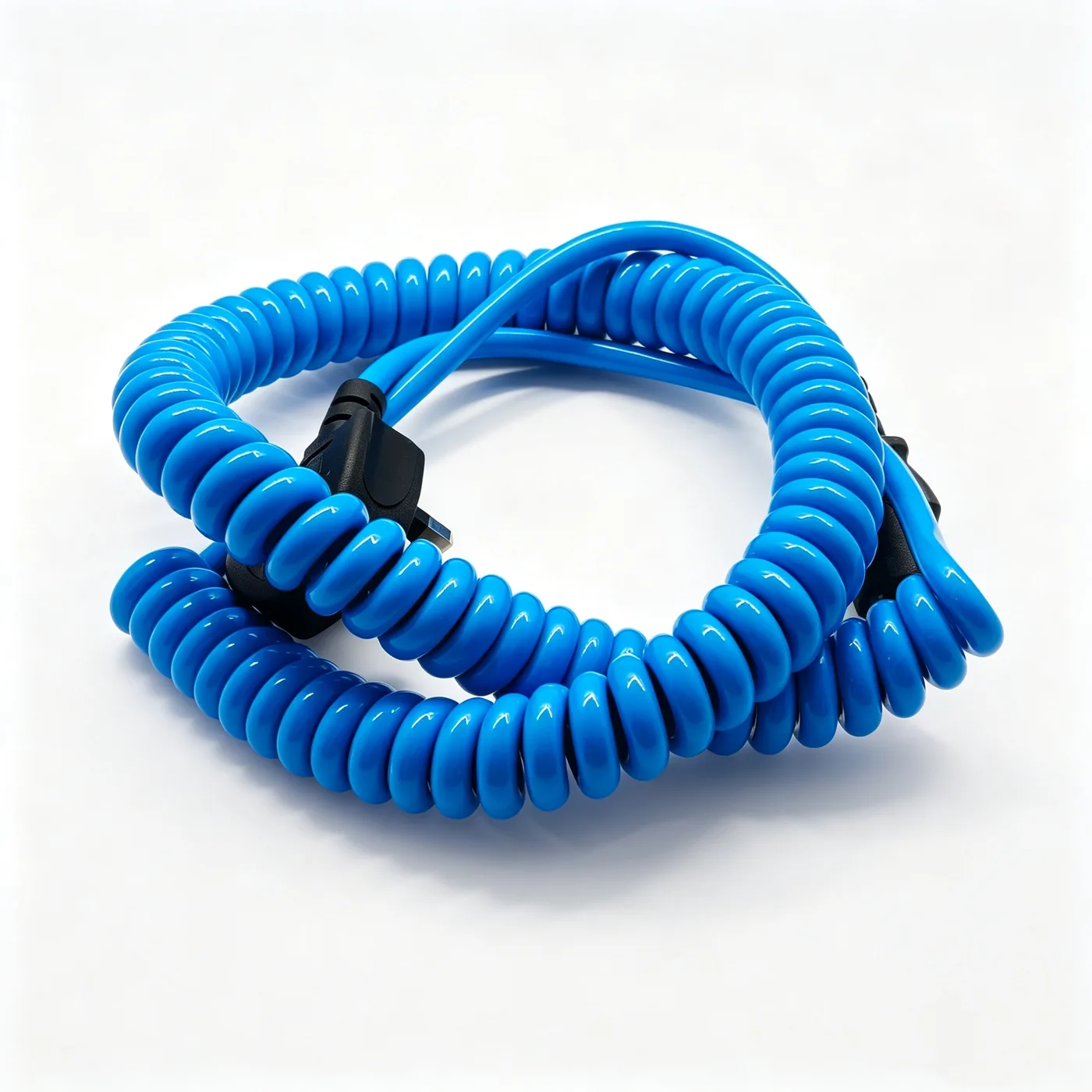
TPU spring cable 3x1.5
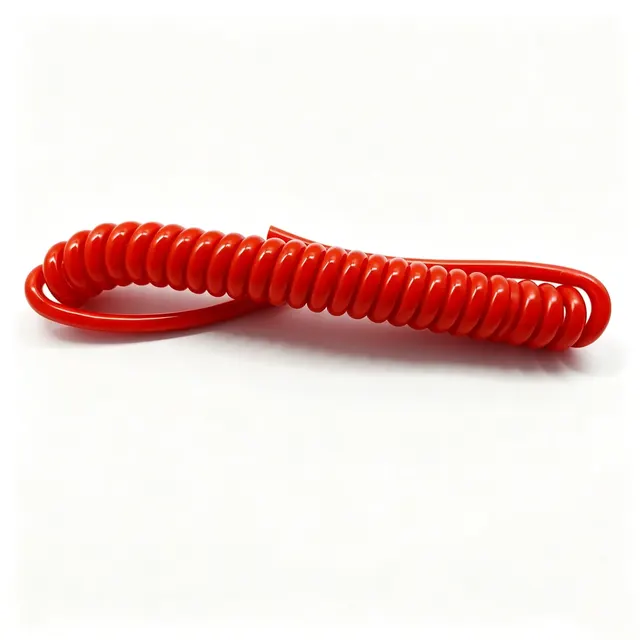
TPU spiral spring cable with three 1.5 mm² bare copper cores, PP insulation and 7.6 mm OD, 5200 mm straight length, 560 mm retracted helix.
Product overview
Spiral cable, also called spring cable, is a movable connecting cable made by winding a straight cable into a helix that extends when pulled and retracts automatically when released. It is used where equipment reciprocates within a limited travel, or where the cable has to be payed out and taken up repeatedly. This model is a TPU spring cable from the industrial automation range, with a nominal cross-section of 1.5 mm² and a thermoplastic polyurethane (TPU) sheath; the cable is flexible and of small diameter, meeting both the need to take power while moving and to retract automatically.
A spiral cable consists of a helical section in the middle and straight sections at both ends: the straight sections are for fixed installation and connection, and the helix takes the extension travel. When stretched, the coils open and the distance between the load point and the fixed point increases; when the force is removed, the elasticity of the material restores the original shape, so no separate cable reel or take-up mechanism is needed. The site layout stays simple and the cable does not trail loose on the floor.
Construction and materials
- Conductor: stranded bare copper, left-hand lay, conductor diameter 1.58 mm
- Insulation: PP, 0.5 mm thick, insulated core diameter 2.6 ±0.05 mm, core colors brown, blue and yellow-green
- Cabling: cores cabled left-hand, cabled core diameter 5.6 mm Outer sheath: TPU, 1.0 mm thick, light blue, extruded, finished diameter 7.6 ±0.2 mm
The conductor uses fine copper strands in a left-hand lay, stranded tightly so that each strand carries load evenly when the core is repeatedly stretched and bent, reducing fatigue damage from local stress concentration. Polypropylene (PP) insulation gives stable insulation resistance and low dielectric loss, and the small core diameter helps control the cabled diameter and the stiffness of the whole cable. The yellow-green core is normally used as the earth conductor for connecting the equipment enclosure to the earthing system; take care to identify it during connection.
Cabling follows the order of the cores, with the lay direction opposite to that of the conductors, which reduces the tendency of the cable to twist back. The sheath is extruded over the cabled core and bonds tightly to it, so the helix is stable after winding and setting and does not loosen or wrinkle in long service.
Spring geometry and end configuration
- Straight length 5200 mm, the length of the straight cable before winding
- Retracted helix length 560 mm, the length of the helical section lying naturally flat
- 250 mm straight section left at each end as allowance for fixing and connection
- One end fitted with an IEC C13 plug, the other with a 10 A UK molded plug, plug sheaths black
The length of the straight sections at both ends can be adjusted to the installation space and working practice of the equipment; the socket side is usually given enough allowance for routing and for plugging in. Plug and cable are molded in one piece, so external forces are shared by the sheath and the plug body, reducing the chance of damage to cores and conductors during pulling and swinging. The helix diameter and number of coils are determined by the winding mandrel and the setting process, and can be set according to the mounting position and the permitted extension travel.
Key features
- Sheath material is abrasion resistant and oil resistant and suits low temperatures, for workshop, outdoor and damp environments
- Stable spring return: the cable recovers its original shape after extension and does not tangle or knot easily
- Compact and relatively light, suitable for hand-held devices and portable tools
- Earth core and plug type can be configured to the socket standard of the target market
- Length, plug combination and core count can be adjusted to project requirements
Electrical and mechanical performance
Rated voltage, continuous operating temperature, minimum bending radius, permitted number of extensions and maximum extension ratio vary with conductor cross-section, insulation and sheath material and helix geometry; the values for this model are subject to the specification file confirmed by both parties. During installation and use, do not exceed the specified extension length, avoid repeated bending at the plug root or hanging loads from the cable, and avoid leaving the coiled cable at maximum extension for long periods, so as to preserve spring return and service life.
Typical applications
Spiral cables suit equipment that is moved frequently or whose cable is repeatedly payed out and taken up: power leads for hand-held power tools and portable instruments, power supply for floor cleaning equipment, temporary lighting for maintenance and inspection work, mobile power for stage and film equipment, and connections to reciprocating machine parts. Where installation space is tight and the cable should stow neatly, a helix is easier to arrange than a straight cable and keeps a working range between adjacent equipment.
Selection and customization notes
Selection starts with the operating voltage, current and ambient temperature of the equipment, which determine conductor cross-section and core count; the distance from the fixed point to the load point and the socket standard then determine the retracted helix length, permitted extension length and plug type. Where shielding, reinforced oil resistance, high or low temperature resistance or a longer extension life is required, please contact PAIDE to adjust materials and construction to the project, subject to the specification file confirmed by both parties.
Related in Spiral & Spring Cables
Engineering enquiry