4×10 mm² + 4×1.0 mm² Tethered Balloon Cable, 10000 kg Breaking Load, 25 mm
Tethered Drone Cables · Tethered Systems
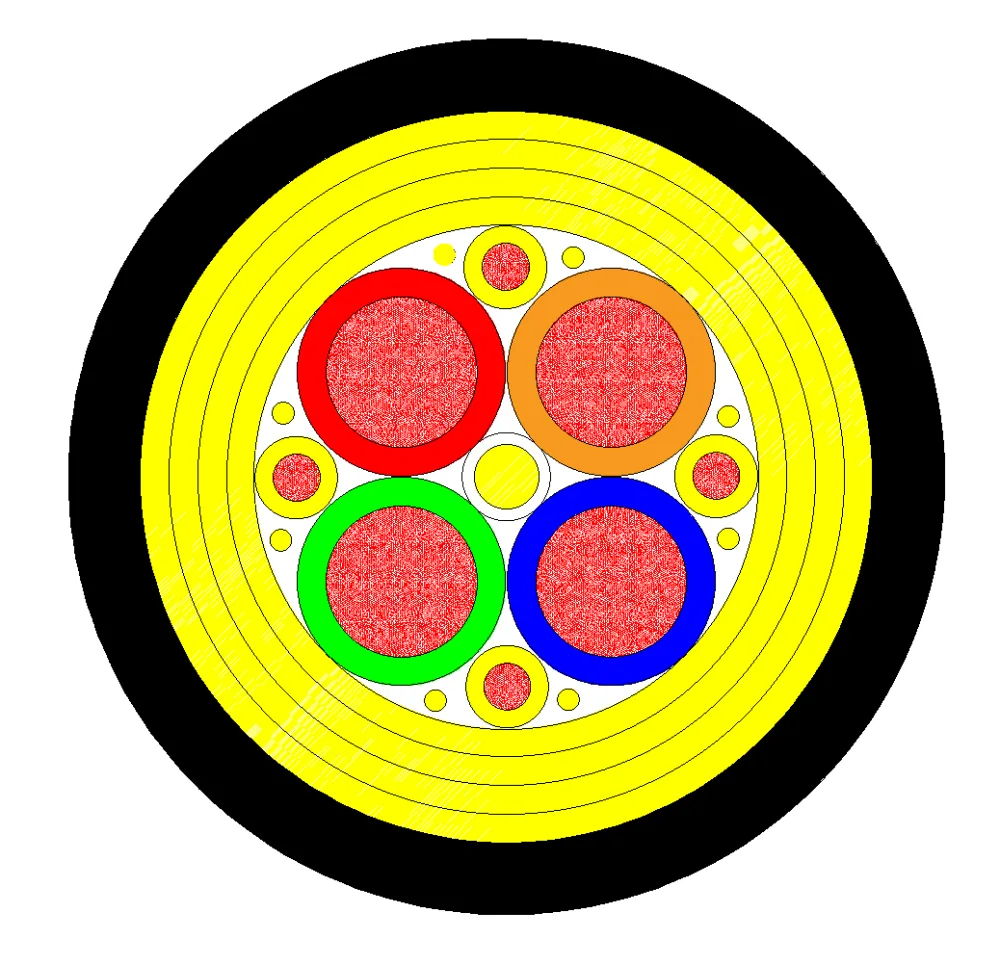
Tethered balloon 4×10+4×1.0-10000KG
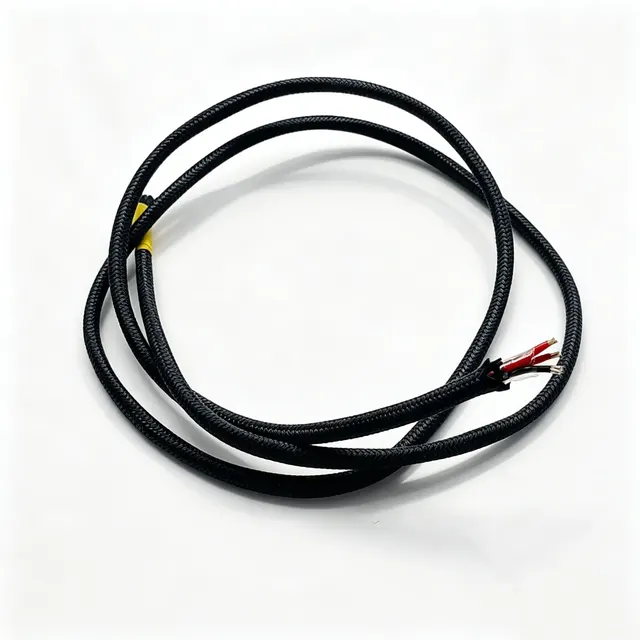
Tethered balloon cable with 4×10 mm² power and 4×1.0 mm² auxiliary cores, layered LCP strength members, PU sheath, 25 mm OD, about 810 g/m.
Product overview
Tethered balloons and tethered drones obtain continuous power and a signal connection through a ground cable, and during long hovering the cable carries its own weight and wind loads as well as repeated bending and friction during deployment. This product uses an eight-core construction: four main power cores deliver power to the platform, four auxiliary cores serve secondary power or control signal return, and a separate strength layer is provided outside the cable, so that transmission and mechanical strength each perform their own function. It suits aerostat platforms with high demands on continuous power supply and reliability.
Construction and materials
The conductors are stranded tinned copper wire. The tin coating slows oxidation of the copper in damp and salt-spray environments and also facilitates subsequent soldering and terminal crimping. The two cross-sections correspond to different circuits:
- Main power cores, 10 mm², multi-strand stranded, stranded diameter 4.3 mm
- Auxiliary cores, 1.0 mm², multi-strand stranded, stranded diameter 1.3 mm
The insulation is a thermoplastic polyester elastomer, whose flexing, abrasion and low-temperature performance is better than that of ordinary polyvinyl chloride, making it suitable for a cable that undergoes repeated small-radius bending during deployment.
- Insulation diameter 5.8±0.1 mm, insulation thickness 0.75 mm
- The insulation is colour-coded red, orange, blue and green, which makes circuits easy to distinguish and connections easy to check after cabling
When the cores are cabled, a PE filler strip is placed at the centre, with 4 fibres embedded in the filler strip and a further 16 × 3000D liquid crystal polymer fibres added in the gaps between cores, so that the core cross-section stays as circular as possible and relative slip between cores under bending is reduced; the cabling diameter is controlled at 14.1±0.5 mm.
The strength layer is built up from liquid crystal polymer fibre of the same specification, stranded in successive layers with non-woven tape wrapped between layers at 100% coverage, so that the fibres in each layer are neatly arranged and do not chafe against each other. The layers are as follows:
- First layer: 57 fibres, stranded in bundles of 3, outer diameter 15 mm after stranding
- Second to fifth layers: 76 fibres per layer, stranded in bundles of 4, with outer diameters of 16.5 mm, 18 mm, 19.6 mm and 21 mm in sequence
Layered stranding spreads the tensile load that the cable must carry over many layers and many bundles per layer, so that the load on each bundle is more even; even if individual bundles are not perfectly aligned, the load does not concentrate at one point, and the cable retains good flexibility while carrying tension.
The outermost layer is a black thermoplastic polyurethane sheath, extruded over the strength layer, 2 mm thick, giving a finished outer diameter of 25±1.0 mm. The fit between sheath and strength layer is based on the measured cabling diameter, so that the sheath lies tight without over-compressing the fibre layer. The measured weight of the finished cable is approximately 810 g per metre.
Key characteristics
- Separate load-bearing and conduction: the strength fibre layer lies outside the core, so tension is carried mainly by the fibre layer and the conductor is not directly loaded, which reduces conductor elongation and core breakage from long hovering and repeated deployment
- Repeated bending resistance: elastomer insulation combined with the layered stranding lets the cable recover its shape after small-radius winding
- Abrasion and weather resistance: the polyurethane sheath has a dense surface and resists abrasion and oil, and also tolerates UV and hot, humid conditions to a degree
- Controlled weight: high-strength fibre strength members keep weight per metre under control while meeting the load requirement
- Stable structure: the filler strip and gap fibres keep the core circular and prevent relative displacement between stranding layers
Electrical and mechanical performance
The conductor material and cross-section determine the DC resistance and current-carrying capacity of the cable; the rated breaking force of the cable has to be established together with hovering height, wind load, power supply method and safety factor. The insulation and sheath materials determine the temperature range, flex life and abrasion class. In hover the cable carries a long-term static load, while in deployment bending, friction and short-term shock are superimposed; the two conditions place different demands on the cable, and the strength structure is normally checked against the more severe deployment condition. These figures vary with the operating conditions; specific values are subject to the specification document confirmed by both parties, and a corresponding construction and performance statement can be provided for the project conditions.
Typical applications
- Tethered balloon platforms: weather sensing, communication relay and aerial lighting units that stay aloft for long periods
- Tethered drones: emergency communication, on-site surveillance, searchlight and survey work requiring continuous power
- Aerostat surveillance and security: long-endurance observation over industrial parks, borders and mining areas, replacing operations that rely on frequent battery-powered take-off and landing
- High-load power supply: platforms requiring several power feeds and control signals at the same time
Selection and customisation notes
- Core count, cross-section and colour coding can be adjusted to the number of powered devices and the circuit layout
- Load rating, outer diameter and weight per metre can be matched to load and hovering height at the design stage
- Sheath hardness, colour and surface treatment can be selected to suit the environment
- Length, reeling method and end termination are confirmed against the on-site deployment equipment
- Where optical signals or a data bus must also be transmitted, the corresponding units can be incorporated in the core
PAIDE Cable can match conductor, insulation, strength layer and sheath layer by layer and provide structural design and sample validation of the tether for the project conditions, balancing mechanical strength, flexibility and weight.
Related in Tethered Drone Cables
 2×20AWG
 7×0.5
 Drone cable 2x22AWG+2x1 fiber
 Drone cable 4×1.2
Engineering enquiry