PDK41602-6×1mm²+1SMF Tethered Drone Cable 150kg
Tethered Drone Cables · Tethered Systems
PDK41602
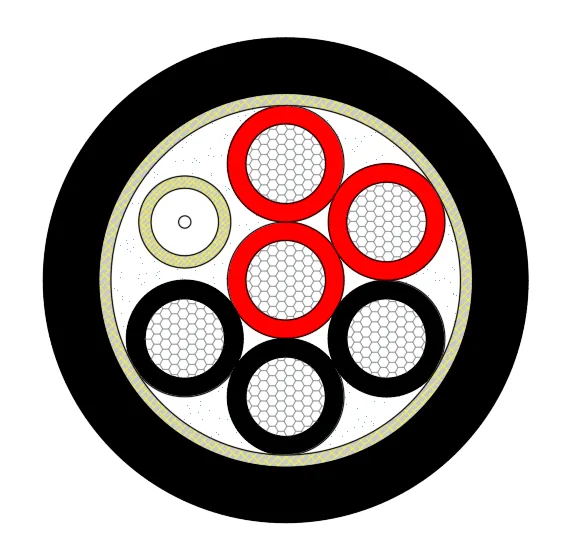
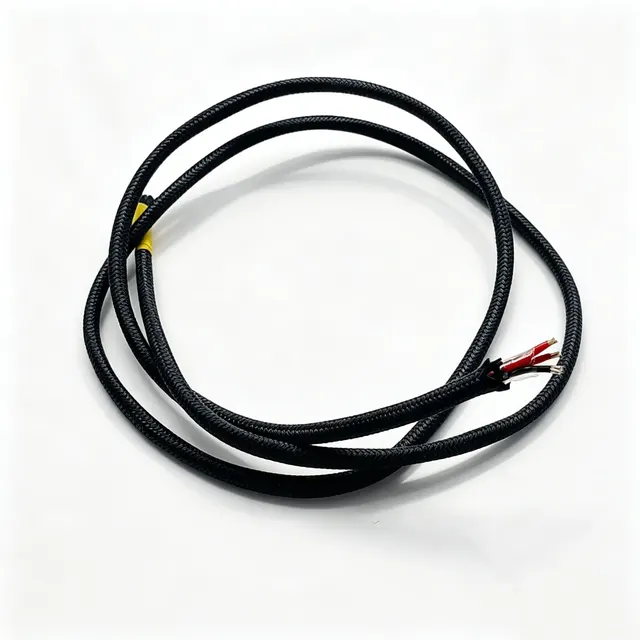
Tethered drone cable combining 6×1mm² tinned copper power cores with 1 single-mode fibre, 30-35A, 7.9mm TPU jacket, 150kg LCP braid, 1/1.2kV.
Product overview
Tethered drones draw continuous power from a ground supply through the tether cable instead of an onboard battery, which allows long endurance; the same cable also carries flight control commands and image data back to the ground. The PDK41602 series was developed for this duty, integrating power conductors and a fibre unit in one cable so that power and communication are both covered. PDK41602-6×1mm²+1SMF consists of 6 power cores plus 1 fibre bundle; it suits tethered platforms that are sensitive to both cable diameter and payload weight, and can be used with a spooling system or directly for flight tethering. Materials, dimensions and electrical data are given in the construction and materials and the electrical and transmission performance sections; this section is a qualitative description only.
Construction and materials
The conductor is tinned copper, stranded, with a stranded diameter of 1.3mm. The tin coating improves resistance of the core to oxidation in hot, humid and salt spray conditions and also aids subsequent soldering and crimping.
The insulation is extruded FEP fluoroplastic: insulated core diameter 1.9mm, average insulation thickness 0.3mm, minimum above 0.25mm; within the cable, 3 red and 3 black cores distinguish polarity and circuit. One fibre bundle is also included, with an outer diameter of 1.1mm, protected by a braid of 1000D LCP fibre, giving a finished fibre unit diameter of 1.5mm.
Polyester yarn is used as filler during cabling to keep the assembly round, then 16 ends of 1500D LCP fibre are braided over it as reinforcement, and finally a black TPU outer jacket is extruded. The jacket has an average thickness of 0.9mm and a minimum of 0.8mm; the finished outer diameter is 7.9±0.3mm and the weight is about 110 g/m. The TPU jacket combines abrasion resistance with flexibility and withstands the rubbing and dragging of repeated deployment.
Key characteristics
- Power conductors and fibre in one cable, so a single cable carries both power and signal;
- Using fibre instead of copper for data and flight control signals extends the effective transmission distance and provides electrical isolation between the airborne section and ground equipment, reducing interference coupling in strong electromagnetic environments;
- The LCP fibre braid raises tensile capacity while staying flexible, which suits repeated deployment during take-off and landing;
- The jacket material has some resistance to UV and damp conditions, suitable for long-term outdoor work;
- The wide operating temperature range covers typical ground and low-altitude climates;
- Cable diameter and weight per metre are controlled to reduce the load on the airborne section.
Electrical and transmission performance
- Rated voltage: 1/1.2 kV
- Continuous current: 30-35 A
- Maximum conductor DC resistance at 20℃: 18.7 Ω/km
- Fibre attenuation: ≤0.5 dB/km at 1310nm, ≤0.3 dB/km at 1550nm
- Rated temperature: -40℃~+105℃
- Minimum bending radius: 20D, where D is the cable outer diameter
Both cable ends can be terminated to suit the platform connector for quick replacement in the field; where the platform requires a different current capacity or cable diameter, the specifications can be fixed against the related models in the next section.
Related models and selection reference
Besides PDK41602, our tethered drone and tether cable range includes several product families that can be selected by current level, conductor cross-section, core count and whether a fibre is included. Key parameters of some models are listed by family below for initial comparison.
In the PDK41300 series, the 2×0.5 size has a finished outer diameter of 3.7±0.2 mm and a rated voltage of 600~1000 V; the 2×0.6+2SMF size in the same family is 3.6±0.2 mm at 750 VDC; the 2×1.2 size is 4.2±0.2 mm at 750 V. PDK41301-2×0.5 has a finished outer diameter of 3.4±0.1 mm. In the PDK41901 series, the 2×0.8 size is 3.5±0.2 mm, the 2×1.2 size has the same finished outer diameter as the PDK41300 size of the same cross-section, and the 4×1.2 size is 5.0±0.2 mm at a rated voltage of 750~1000 VDC. Among these sizes, PDK41301-2×0.5 and all three PDK41901 sizes are marked 800 VDC; the minimum bending radius is 15D for all except the two 2×1.2 sizes, which are 25D; the temperature range is -55℃~150℃ for all except PDK41300-2×1.2, which is -60℃~200℃.
Note that finished outer diameters differ between cross-sections within the same family. The 0.35mm² sizes in the PDK41300 series have two finished diameters, 2.35±0.2 mm and 2.45±0.2 mm; the 0.5mm² size is 2.55±0.2 mm and the 0.6mm² size is 2.8±0.15 mm.
Where higher current capacity is required, a large-cross-section composite such as PDK41901-8×5mm²+1SMF can be selected. Its conductor is an alloy wire construction, stranded per core, with an insulation diameter of 3.75±0.1 mm; it contains one G657A2 single-mode fibre, uses Kevlar braid, has a finished outer diameter of 13.2±0.5 mm, a rated voltage of 1500 V, a continuous current of 100 A and a peak current of 120 A, maximum conductor DC resistance 4.9 Ω/km (measured under the same temperature conditions as above), tensile strength 150KG, the same minimum bending radius as this model and the same rated temperature as the 2×1.2 size above. Selection should be based on the formal specification for the relevant size and on sample verification results.
Typical applications
- Ground power supply and data return for tethered drones, supporting long-endurance observation, communication relay, emergency lighting and monitoring;
- Power and control signal connections between tethered aerostats and the ground station;
- Airborne wiring sensitive to cable diameter and weight, where power and optical paths must run in the same confined space;
- Applications where fibre is used to isolate electromagnetic interference and extend transmission distance;
- Repeated bending duty with a spooling take-up mechanism.
When tethering, the cable length and fixing method should be determined from the actual pull, deployment speed and bending radius of the platform, avoiding prolonged local bending below the minimum radius.
Storage and handling
Store the cable in a dry, ventilated place and avoid long-term contact with sharp objects or heavy stacking; the bending radius when coiling should not be less than the specified value. Before use, check the appearance of the jacket and fibre unit and confirm there are no cuts, flat spots or excessive kinks. For long-term outdoor work, check the cable surface and connector condition at intervals to keep power and signal transmission stable. If the platform has firm limits on weight, outer diameter or tensile rating, state them at the selection stage so that a suitable cross-section and strength construction can be matched.
Customisation and ordering notes
Before selection, clarify the continuous and peak current, supply voltage, required core count and conductor cross-section, communication method and fibre type, operating temperature range, tensile strength requirement and deployment method, then fix the model and construction. Beyond the sizes listed above, core combinations, conductor cross-sections, fibre type and count, jacket material and colour, print marking, length and packing can all be supplied to order. Parameters and construction are subject to the formal specification; for a different design, contact us to discuss a custom solution.
Related in Tethered Drone Cables
Engineering enquiry