Single-Sheath Buoyant Cable 2x14AWG+17AWG+1x2x22AWG - 13.7 mm OD, Near-Neutral Buoyancy
Zero-Buoyancy Cables · Marine & Subsea
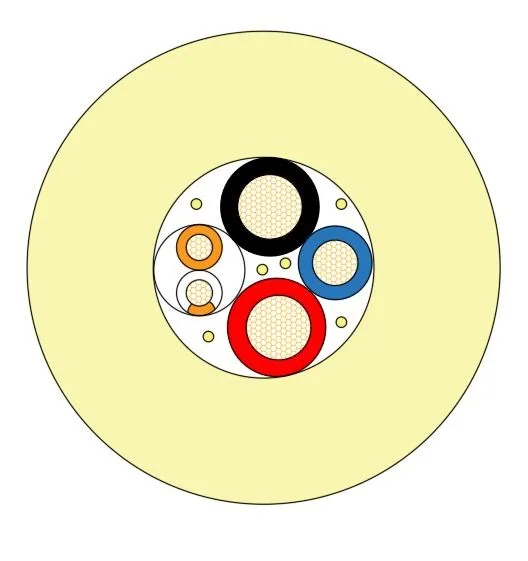
Single-sheath buoyant cable 2x14AWG+17AWG+1x2x22AWG
Single-sheath near-neutrally buoyant subsea cable combining 14AWG power, a 17AWG auxiliary core and a 22AWG twisted pair, foamed TPU sheath, 13.7 mm OD.
Product overview
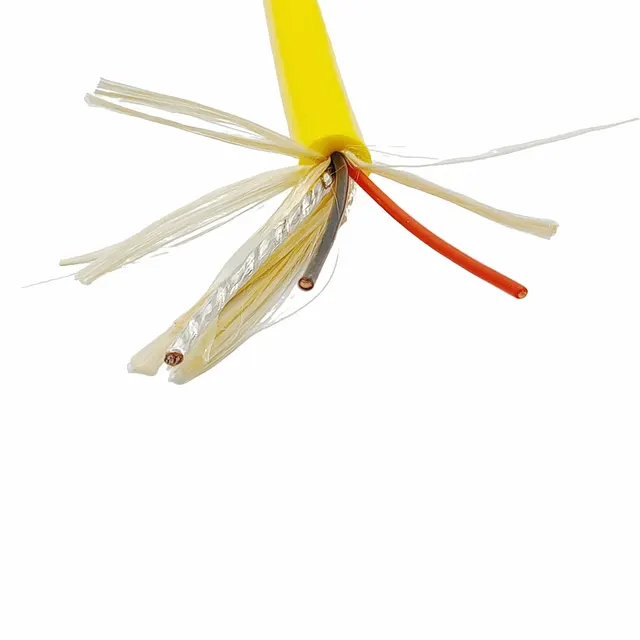
This single-sheath buoyant cable is designed for subsea working environments and carries both power and signal in one cable body. The cable is wrapped in a foamed outer sheath, and high-strength load-bearing fibers inside take the axial pull, so the net weight of the cable in water is clearly lower than that of a conventional rubber-sheathed cable of the same cross-section. The cable approaches neutral buoyancy, so it does not create a downward drag as it follows equipment down and does not readily pile up or knot near the umbilical.
Compared with double-sheath products of the same class, the single-sheath design balances outer diameter and flexibility: with fewer sheath layers the restoring force in bending is lower, which suits operations that require frequent deployment and recovery with a small coiling radius. The cable can be used for fixed connections on subsea equipment or for moving connections that follow equipment up and down; the termination is determined by the equipment interface.
Construction and materials
- Conductor: stranded bare copper; the two main power cores are multi-strand, the auxiliary power core is multi-strand, and the signal pair cores are multi-strand.
- Insulation: PE; main power core 0.47 mm thick, auxiliary power core 0.40 mm thick, signal core 0.27 mm thick
- Signal pair: two cores with a nominal cross-section of 0.34 mm2, orange and white, twisted pair
- Strength member: 7 pcs 3000D liquid crystal polymer fibers, cabled in the same direction as the core and wrapped with non-woven tape; cabled diameter 6.3 ±0.3 mm
- Outer sheath: foamed TPU, 3.2 mm thick, yellow
All conductors are multi-strand bare copper, each core bunched in a left-hand lay, with lay tightness set individually by core diameter: the larger power cores are laid longer so that the strand stays compact and the conductor does not open up, while the smaller signal cores are laid tighter so that the core stays rounder and each wire shares load more evenly in bending. Compared with a single solid conductor of the same cross-section, the multi-strand construction is less prone to work-hardening and wire breakage under repeated flexing.
The insulation is PE (polyethylene), which has a low dielectric constant and high volume resistivity and absorbs little water in permanently damp conditions, giving the power and signal cores a stable insulation resistance. The core groups are distinguished by red, black, blue, orange and white, so that phase and polarity can be matched by color during installation, reducing wiring errors underwater and making faults quicker to locate during maintenance.
The signal pair uses a twisted construction: the two insulated cores are twisted together so that voltages induced by external electromagnetic interference appear in opposite directions and cancel, improving signal stability; the completed pair is then cabled together with the power cores, avoiding direct coupling from the power circuit into the signal circuit.
The strength member is made of high-strength liquid crystal polymer fiber and is laid out separately from the copper conductors inside the core; axial pull is carried mainly by the fiber and the copper conductors take no load, which prevents them from being drawn down or broken during deployment, recovery and lifting. At cabling, non-woven tape is wrapped around the core to separate, cushion and shape it, keeping the cores in stable relative positions and preventing the core from being flattened when the sheath is extruded.
The outer sheath is foamed TPU, formed in one extrusion pass. The foamed structure lowers material density while maintaining water pressure resistance, abrasion resistance and tear strength, and provides buoyancy compensation for the cable; the yellow sheath is clearly visible underwater, which helps to follow the cable route and to locate snags and inspection points.
Key features
- Near-neutral buoyancy: the net weight of the cable in water is low, so it creates little downward pull as it follows equipment down and the line attitude is easier to control.
- Hydrolysis and water pressure resistance: the sheath material remains stable under long-term immersion, which suits continuous subsea operation.
- Oil, abrasion and tear resistance: suitable for docks, ship sides and subsea machinery where mechanical rubbing is frequent.
- Good flexibility: the foamed sheath has low stiffness and a small bending radius, which eases coiling, deployment and storage.
- Interference rejection: the twisted signal pair suppresses common-mode interference, so power and signal can share one cable.
- Easy identification: the sheath color is conspicuous and the cores are color-coded, which speeds up installation and maintenance on site.
Finished dimensions and mechanical performance
- Finished outer diameter: 13.7 ±0.3 mm
- Loading: mainly axial tension and repeated bending fatigue, with the strength fibers and copper conductors laid out separately
- Diameter consistency: sheath thickness is controlled by the foaming process and the cable profile is even, which eases fitting seals and subsea connectors
This construction does not fix electrical parameters such as rated voltage, temperature class, insulation resistance or withstand test voltage, nor mechanical parameters such as minimum bending radius, permitted pull or single length; these are determined by project requirements and actual values are subject to the specification document confirmed by both parties.
Typical applications
- Power and signal composite connection for underwater vehicles and remotely operated vehicles
- Cables for subsea cameras, lighting and survey instruments
- Short-distance connections for ocean observation platforms and hydrological monitoring equipment
- Shipboard subsea pumps, thrusters and actuators
- Subsea sensor arrays and data acquisition systems
In these applications the cable is often deployed and recovered repeatedly and moves with the equipment, which places high demands on weight, bending flexibility and sheath abrasion resistance; the single-sheath foamed construction is well suited to this. Final selection still needs to consider working depth, handling method, termination type and tensile conditions together.
Selection and customization notes
- Conductor cross-section, core count and number of signal pairs can be adjusted to the power and signal requirements of the equipment.
- The strength member specification can be configured to the actual pull requirement, to match different working depths and operating frequencies.
- Sheath color and buoyancy level can be adjusted to project requirements; where more buoyancy is needed, the foam layer can be made thicker or buoyancy elements added.
- Terminations can match the equipment interface, and length is customized to the actual routing distance.
- When selecting, please state the working depth, number of deployment cycles, permitted bending radius and surrounding medium, so that the construction and sheath material can be determined.
For other constructions or specifications, please contact the PAIDE technical team to confirm the design.
Related in Zero-Buoyancy Cables
Engineering enquiry