Single-Sheath 1-Core Fibre Optic Buoyant Cable, 200 kg, 3 mm
Zero-Buoyancy Cables · Marine & Subsea
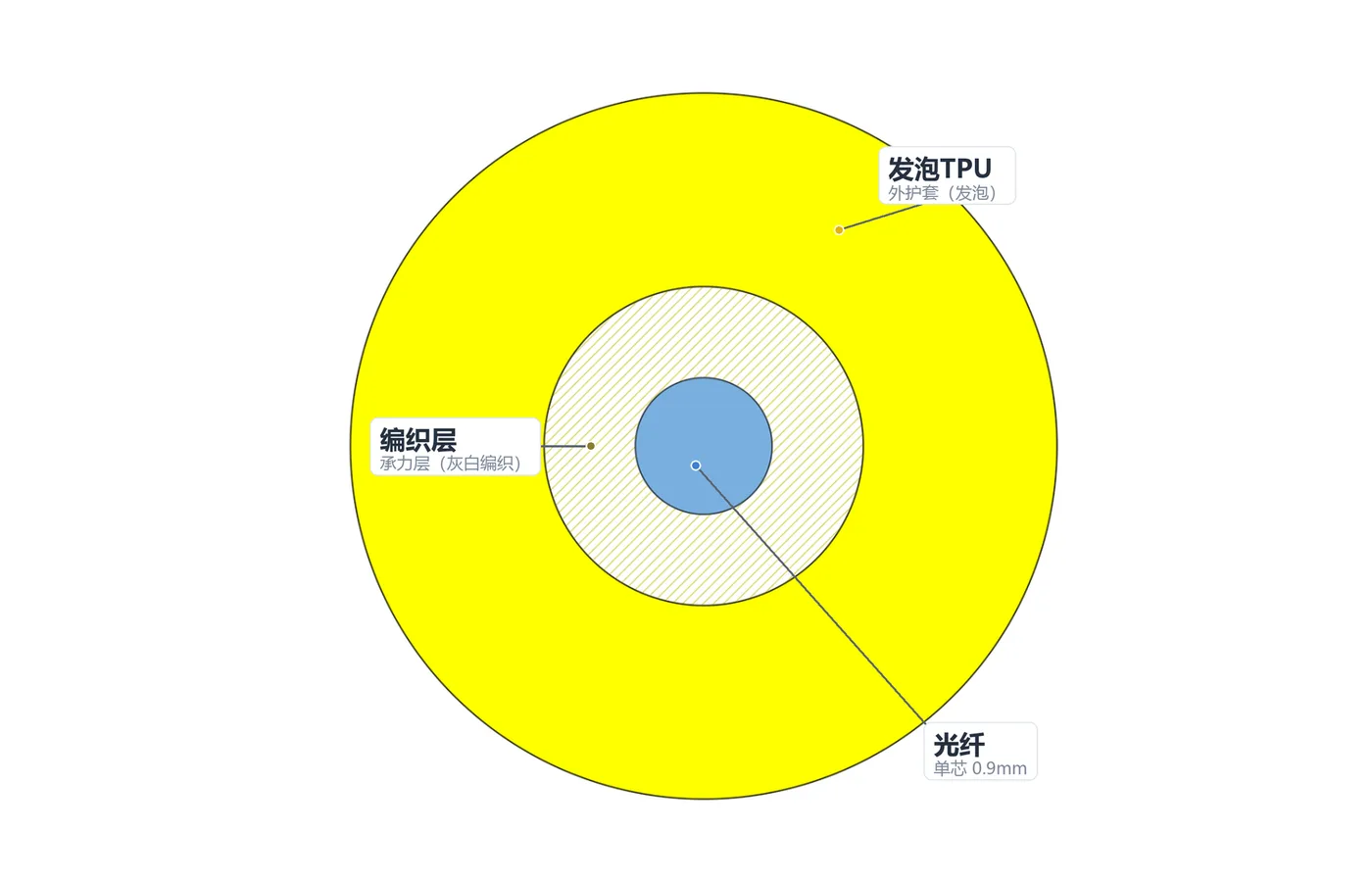
Buoyant cable, single sheath, 1-core fibre, 200 kg tensile
Single-sheath buoyant fibre optic cable with one 0.9 mm fibre, 200 kg aramid strength layer and foamed TPU sheath, 3 ± 0.2 mm finished diameter.
Product overview and applications
Buoyant cables are a class of specialty cable developed for underwater working environments. Their main difference from conventional underwater cables lies in the sheath construction: a foaming process creates fine cells inside the sheath, lowering the specific gravity of the material so that the cable becomes buoyant in water. This reduces the load on underwater equipment and the amount of ballast required, and it also lowers the risk of the cable sinking to the bottom and snagging on underwater obstacles.
The product described here uses a single-sheath construction with one optical fibre as the core, concentrating the signal path in the fibre, while a strength layer combining longitudinally laid fibres and a braid carries the mechanical tensile load. The cable body is slim and flexible and can be routed freely with the attitude of the underwater equipment, which suits operations that need signal return but cannot easily add ballast.
Compared with copper-conductor underwater signal cables, the advantage of this type is that the signal travels as light: it is unaffected by the electromagnetic interference produced by motor and thruster currents during underwater work, and over long distances there is no concern about attenuation rising with conductor resistance. Because no metallic conductor or shield layer is required, the cable body can be made thinner and lighter, which makes deployment, recovery and coiling easier. It should be noted that precisely because the construction is slim and the materials are soft, greater care is required in service with regard to tensile load, bending and end-face protection; only proper handling ensures long-term reliability.
Construction and materials
From the inside out, the cable is divided into three layers, namely the fibre unit, the fibre strength layer and the outer sheath, each with a distinct function.
- Fibre unit: single-core fibre, 0.9 mm outer diameter, transparent
The fibre sits at the centre of the core and carries the signal. Its transparent construction makes it easy to observe the state of the fibre during termination, and to judge during assembly whether the fibre has been damaged.
The fibre strength layer is the key to a small-diameter optical cable. The strength elements consist of high-strength fibres in two linear densities: the heavier group is laid straight along the core with little elongation and carries the main tensile load; the finer group is applied as an outer braid, which provides coverage and protection, also shares the load, and restrains displacement of the core under repeated bending and twisting.
- Strength elements: 2 × 3000D fibres laid straight longitudinally, 8 × 1500D fibres in a 16-spindle braid, 80% coverage
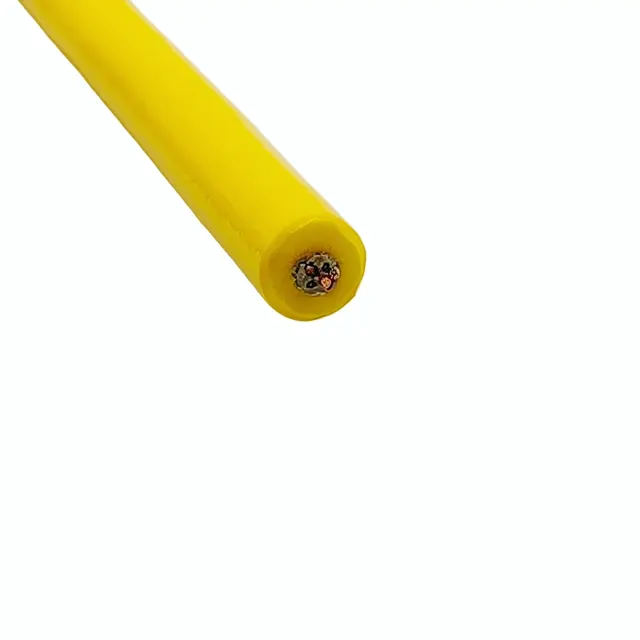
- Outer sheath: foamed TPU, 0.6 mm thick, yellow
- Finished outer diameter: 3 ± 0.2 mm
The outermost layer is an extruded foamed TPU sheath. TPU is abrasion-resistant, hydrolysis-resistant and oil-resistant and remains flexible at low temperature; once foamed it becomes lighter and softer, providing sealing against water and mechanical protection while contributing to overall buoyancy. The sheath is a high-visibility yellow for underwater observation and identification.
Key features
- Low specific gravity: the foamed construction reduces the weight the cable experiences in water, clearly cutting the ballast needed during deployment.
- Slim and flexible: a small overall diameter and good bending performance make routing and handling easier in the tight spaces of underwater equipment.
- Load separation: tensile load is carried directly by the strength fibres, so the fibre itself sees almost no tensile load.
- Two-layer protection: braid and sheath together protect the fibre core and reduce transmission risks from scratching and compression.
- Environmental tolerance: the sheath material resists hydrolysis, abrasion and oil, and suits long-term underwater or damp service.
- Interference immunity: the signal is optical and is unaffected by normal electromagnetic environments.
Electrical and mechanical performance
- Tensile capacity: 200 kg; the strength rating can be adjusted to the deployment conditions.
- Transmission performance: fibre type, attenuation and bandwidth are defined by project requirements; specific values are subject to the specification document confirmed by both parties.
- Bending performance: the cable body is soft; the permissible bending radius in practice should be confirmed against the installation method and the specification document.
- Service temperature: to be agreed according to the project environment.
Typical applications
Signal connections for underwater observation and survey equipment; communication and video return for underwater robots and cameras; deployment and signal collection for underwater sensor arrays; hydrometric monitoring, aquaculture and other cases where cable must be laid in water for long periods; and connections between ship, shore and in-water equipment. For work involving frequent deployment over complex seabeds, the slim buoyant construction reduces handling effort and the likelihood of the cable fouling obstacles.
Installation and maintenance notes
- During deployment and pulling, tensile load should act on the strength fibres as far as possible; avoid pulling directly on the fibre at the ends, and anchor and protect the cable ends.
- Route the cable away from sharp edges, burrs and rotating parts so that the sheath is not scratched and its sealing function lost.
- Do not coil or turn below the permissible bending radius, and avoid storing the cable coiled at a small radius for long periods.
- During storage and transport, avoid stacking heavy objects on the cable for long periods, keep it away from high-temperature sources and minimise prolonged direct sunlight.
- Inspect the sheath visually at intervals; damage, bulging or exposed fibres should be dealt with promptly so that water does not enter the core through the damaged area.
- Keep the connectors at both ends and the fibre end faces clean, and clean them before mating so that dust does not degrade transmission.
Selection and customisation notes
Three points should be established first when selecting: the number of signal channels and the fibre type required; the operating depth, deployment method and handling frequency; and the connector type at each end together with the length required.
- Fibre count and fibre type can be customised to project requirements.
- Sheath colour and print marking can be adjusted on request; the marking text is subject to mutual confirmation.
- Strength rating, cable length and end termination can be customised to the deployment conditions.
- Finished outer diameter, bending radius and other technical conditions are subject to the specification document confirmed by both parties.
For greater depths and frequent handling, state the loading mode at the selection stage, whether suspended, towed or fixed installation, so that the appropriate strength configuration and sheath construction can be determined.
Related in Zero-Buoyancy Cables
 Buoyant cable 3x0.75+STP CAT6
 Double-layer neutrally buoyant cable 2×14AWG+24AWG+1SMF
 Double-layer zero-buoyancy 2×0.75 + (1×2×0.2)P
 Double-sheath buoyant cable 2×0.5mm²+2×1SMF
Engineering enquiry